Muffler Delete MPG Estimator
Most drivers expect a muffler delete to improve mileage. This tool helps you determine if it will actually help your specific vehicle scenario or if you are better off saving that money.
Awaiting Input
Fill out the profile on the left to see your estimated results.
Why does this happen?
Factory exhaust systems are optimized using computational fluid dynamics. For most modern cars, removing the muffler reduces backpressure so slightly that the ECU doesn't adjust significantly. However, changes in pressure waves can confuse oxygen sensors, causing the computer to inject more fuel (running rich), which lowers MPG. Additionally, increased noise often leads to aggressive driving habits, further reducing efficiency.
You see a guy at the gas station with a loud rumble coming from his tailpipe. He claims he gained 3 miles per gallon just by cutting off the muffler. You look at your own fuel gauge, wondering if that heavy metal canister is actually eating up your money at the pump. It’s a common myth in car enthusiast circles: remove the restriction, let the engine breathe, and watch the efficiency numbers climb. But does physics agree with the garage folklore?
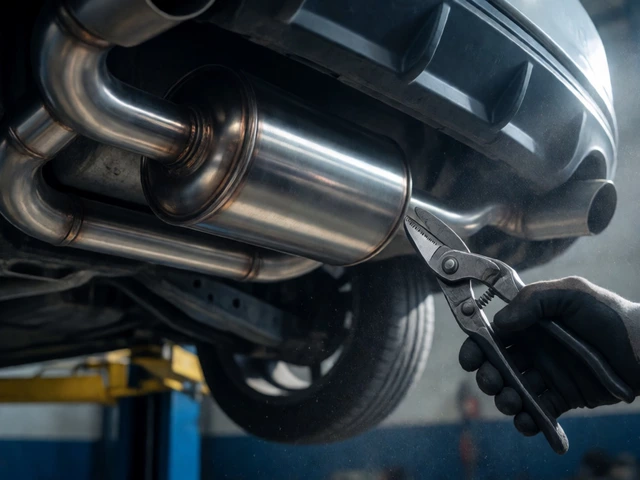
The short answer is complicated. For most daily drivers, a muffler delete is the removal of the muffler component from a vehicle's exhaust system to reduce backpressure and alter sound characteristics rarely yields a measurable gain in fuel economy. In fact, for many modern vehicles, it might do nothing or even slightly hurt efficiency due to how engines are tuned. However, there are specific scenarios where removing restrictions helps. Let’s break down what actually happens under the hood when you cut that pipe.
The Myth of Backpressure and Efficiency
To understand why people think this works, you have to understand exhaust backpressure is the resistance to flow within the exhaust system that opposes the expulsion of spent gases from the engine cylinders. The theory goes like this: the muffler creates a bottleneck. This bottleneck forces the engine to work harder to push exhaust out. If you remove the bottleneck, the engine spends less energy pushing air, so it burns less fuel.
This logic holds water only if the original exhaust system was poorly designed or severely clogged. Factory exhaust systems are engineered by teams of engineers using computational fluid dynamics. They balance noise reduction, emission control, and flow efficiency. A stock muffler usually adds minimal resistance-often less than 1-2 psi (pounds per square inch) at idle and low RPMs. Removing this tiny amount of resistance doesn’t free up enough horsepower to offset the aerodynamic or mechanical losses elsewhere. Most dyno tests show that a simple muffler delete on a stock engine results in zero to negligible horsepower gains, which means zero to negligible fuel savings.
When a Muffler Delete Actually Helps
There are exceptions. If you drive a heavily modified vehicle, particularly one with forced induction (turbocharged or supercharged), the story changes. High-performance turbo engines rely on efficient scavenging to spool the turbo faster. Here, restrictive exhaust piping can hinder performance. By installing a straight-pipe system or a high-flow resonator instead of a standard muffler, you reduce turbulence.
However, even here, the fuel economy benefit is indirect. If the engine runs more efficiently because it doesn’t have to fight as much resistance, you might get slightly better throttle response. Better throttle response often leads drivers to use less pedal input to maintain speed, which *can* improve MPG. But this is a driver-behavior effect, not a direct mechanical efficiency jump. Additionally, older carbureted cars might see slight improvements because their fuel delivery isn’t managed by an oxygen sensor that gets confused by exhaust flow changes. Modern fuel-injected cars? Not so much.

The Hidden Costs: Noise and Emissions
Before you grab the sawzall, consider what else changes. A muffler doesn’t just silence noise; it helps manage exhaust pulse timing. Some modern mufflers contain baffles that aid in low-end torque production. Removing them can sometimes cause a slight dip in low-RPM power, making you press the accelerator harder to merge onto highways. Harder acceleration burns more fuel.
Then there’s the legal and environmental aspect. A catalytic converter is an emissions control device that converts toxic pollutants in exhaust gas into less-toxic pollutants using catalysis usually sits before the muffler. Deleting just the muffler keeps the cat intact, which is good for emissions but bad for neighbors. The drone frequency created by a straight pipe can be annoying at highway speeds. Constant vibration and noise fatigue can make driving stressful, leading to erratic driving habits that kill fuel economy.
| Metric | Stock System | Muffler Delete | Net Change |
|---|---|---|---|
| Fuel Economy (MPG) | Baseline | No change or -0.5 MPG | Negligible to Negative |
| Horsepower | Baseline | +0 to +5 HP (high RPM only) | Marginal Gain |
| Torque (Low End) | Optimized | Potential Loss | Negative |
| Noise Level | Regulation Compliant | High Drone/Rumble | Significant Increase |
| Resale Value | Standard | Lower (niche appeal) | Negative |
Modern Engine Tuning and Oxygen Sensors
Your car’s computer, the ECU, relies on data from oxygen sensors are electronic sensors that measure the proportion of oxygen in the exhaust gases of internal combustion engines to adjust the air-fuel mixture. When you remove the muffler, you change the pressure waves traveling through the exhaust pipe. These pressure waves affect how quickly exhaust gases exit the cylinder and how fresh air enters (scavenging).
If the pressure wave dynamics change too drastically, the oxygen sensors might read incorrectly. The ECU might interpret the change as a lean condition and inject more fuel to compensate. More fuel equals worse MPG. This is why some people report their cars running rich after a muffler delete. Unless you pay for a custom tune to recalibrate the ECU for the new exhaust flow, you’re likely fighting against the factory programming.

Better Ways to Improve Fuel Economy
If your goal is strictly saving money at the pump, skip the exhaust shop and look elsewhere. The biggest gains come from maintenance and behavior, not aftermarket parts. Check your tire pressure. Under-inflated tires increase rolling resistance significantly. A drop of 1 PSI can cost you 0.2% in fuel economy. Keep your tires at the manufacturer’s recommended cold pressure, not the maximum number printed on the sidewall.
Next, check your air filter is a device used to remove contaminants from the air entering an engine or cabin. A clogged air filter restricts airflow, forcing the engine to work harder. Replacing a dirty air filter can improve acceleration and potentially save fuel, though modern cars are sensitive to filter quality. Stick to OEM or high-quality replacements rather than cheap knock-offs that don’t seal properly.
Air conditioning usage also plays a huge role. Running the AC compressor puts a load on the engine. At lower speeds, opening windows might be more efficient. At highway speeds, open windows create drag, making the AC the better choice for fuel economy. Experiment with your specific vehicle to find the crossover point.
The Verdict: Is It Worth It?
For 90% of drivers, a muffler delete will not increase MPG. You won’t see the needle move on your dashboard. You might feel a slight difference in throttle response at high RPMs, but that comes with increased noise and potential legal issues depending on your local laws. If you want better fuel economy, focus on proper tire inflation, regular oil changes, and smooth driving habits. Save the muffler delete for those who prioritize sound over savings, or for heavily modified track cars where every ounce of weight and flow matters.
Does deleting the muffler void my warranty?
Not automatically. Under the Magnuson-Moss Warranty Act in the US, a dealer must prove that the modification caused the failure to deny a claim. However, if your exhaust leak damages other components, they might argue it contributed to the issue. It’s safer to keep the original muffler to reinstall before service visits.
Will a muffler delete damage my engine?
Generally, no. A simple muffler delete does not harm the engine mechanically. However, removing the catalytic converter along with the muffler can lead to failed emissions tests and may trigger check engine lights. Long-term exposure to unfiltered hot exhaust gases near heat-sensitive components should be monitored.
Is a resonator delete better than a muffler delete for MPG?
Neither typically improves MPG significantly. A resonator delete removes a chamber designed to cancel specific sound frequencies. It reduces backpressure slightly more than a muffler delete but still offers negligible fuel economy benefits. It mainly changes the tone of the exhaust note, reducing drone without adding significant volume.
Why do some people say they got better MPG?
Placebo effect is powerful. Also, if the old muffler was rusted shut or partially blocked, removing it restored proper flow, resulting in actual gains. Drivers often unconsciously drive more smoothly when they enjoy the sound of their car, leading to incidental fuel savings.
Can I reverse a muffler delete?
Yes, if you kept the original muffler and clamps. You can simply clamp the old muffler back onto the pipe. If you cut the pipe, you’ll need to weld a new section or use slip-fit connectors, which can introduce leaks if not done correctly.