Clutch Component Diagnostic Tool
Instructions: Click on a symptom or a component below to learn more about its role in the clutch kit and how it fails.
Select a Component
Or Select a Symptom
Select a component or symptom to see a detailed breakdown of the part and its function.
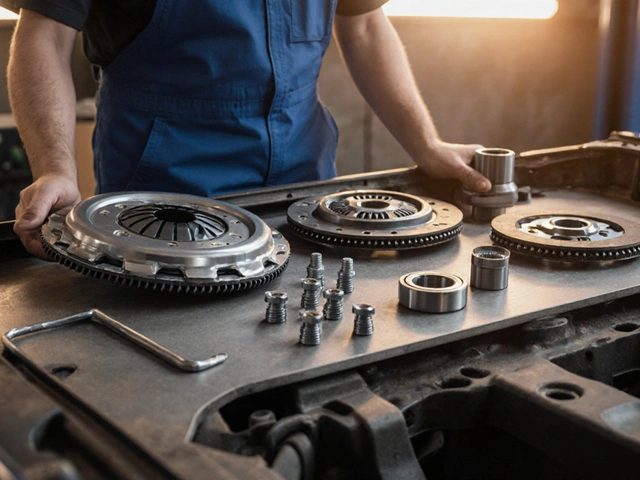
Here is a quick breakdown of what you'll find in most boxes and why each part matters.
- Clutch Disc: The friction material that grips the flywheel.
- Pressure Plate: The heavy-duty spring that clamps the disc.
- Release Bearing: The part that pushes the pressure plate to shift gears.
- Pilot Bearing/Bushing: A small support for the input shaft.
The Heart of the System: The Clutch Disc
The first thing you'll grab out of the box is the Clutch Disc is a circular plate coated with high-friction material that sits between the flywheel and the pressure plate. It acts as the bridge between your engine and your transmission. Think of it like a giant brake pad. When you let the pedal out, the disc is squeezed tight, allowing the engine's power to flow into the gears.
If you look closely at a new disc, you'll see a center hub with splines. These splines slide onto the transmission input shaft. Most discs also feature torsion springs-small coils embedded in the hub. These aren't for suspension; they're there to absorb the shock when you engage the clutch, preventing a jarring "thump" that could damage your transmission gears. If you're buying a performance kit, you might see a "ceramic" or "kevlar" disc. These offer way more grip but can be chattery and harsh in stop-and-go traffic compared to standard organic materials.
The Muscle: The Pressure Plate
The Pressure Plate is a spring-loaded clamping device that pushes the clutch disc against the flywheel to transmit torque. This is the heaviest part of the kit. It looks like a thick metal disc with a diaphragm spring in the center that looks like a series of petals.
Its only job is to apply massive amounts of pressure. When you press the clutch pedal, you're actually pushing against this diaphragm spring to lift the pressure plate off the disc. If the pressure plate is worn or warped, the disc will slip, and you'll notice your RPMs climbing while the car barely accelerates. In a standard kit, the pressure plate is designed to match the friction material of the disc. Mixing and matching brands here is a recipe for a premature failure.
The Pivot Point: Release Bearing and Pilot Bearing
You can't just have the big plates; you need a way to move them. That's where the Release Bearing (also called the throw-out bearing) comes in. This is a small, circular bearing that slides on the clutch fork. Its job is to push the center of the pressure plate to disengage the clutch.
Because the release bearing is constantly moving and under load, it's a common failure point. Have you ever heard a high-pitched squeal that disappears the moment you let go of the clutch pedal? That's almost always a failing release bearing. Since it's a cheap part but requires taking the whole transmission out to replace, every kit includes a new one.
Then there's the Pilot Bearing, a tiny sleeve that sits in the center of the flywheel. It supports the tip of the transmission's input shaft. While it's small, if it seizes or wears out, it can cause vibrations that eventually destroy your new release bearing. It's the unsung hero of the kit.
| Component | Primary Function | Failure Symptom | Material Typical |
|---|---|---|---|
| Clutch Disc | Transmits Torque | Slipping / Loss of Power | Organic/Ceramic |
| Pressure Plate | Clamping Force | Difficulty Shifting | Cast Iron/Steel |
| Release Bearing | Actuates Pressure Plate | Squealing Noise | Steel/Polymer |
| Pilot Bearing | Shaft Support | Transmission Vibration | Bronze/Steel |
What About the Flywheel?
Here is the most important question: Is the flywheel in the kit? Usually, the answer is no. The Flywheel is the heavy metal disc bolted to the crankshaft. Because it's a thick piece of steel, it doesn't "wear out" in the same way as the disc, but it does get scarred or heat-spotted.
You have two choices when dealing with the flywheel. First, you can have it "resurfaced." A machine shop shaves a tiny layer of metal off the top to make it perfectly flat again. Second, you can buy a dual-mass flywheel if your car uses one. Dual-mass flywheels have internal springs to dampen engine vibrations, but they are expensive and often sold separately from the standard kit. If you install a new disc on a scored flywheel, the new disc won't seat properly, and you'll likely experience "clutch chatter"-that annoying shaking when you start from a stop.
Choosing the Right Kit for Your Goal
Not all kits are created equal. Depending on what you do with your car, you'll want different specs. If you're driving a daily commuter, a Stage 1 or OEM-equivalent kit is the way to go. These focus on a soft pedal feel and smooth engagement. You won't have to fight the pedal in traffic, and the car will feel natural.
But if you're building a track car or towing heavy loads, you might look at a Stage 2 or Stage 3 kit. These typically feature a puck-style disc made of ceramic. This material can handle much higher heat without melting, but it's not as forgiving. The pressure plate also has a higher "clamp load," meaning the pedal will feel significantly stiffer. If you've ever driven a race car and felt like you needed a leg workout just to shift, that's a high-clamp load pressure plate at work.
Installation Pitfalls to Avoid
Buying the kit is the easy part; putting it in is where people mess up. One of the biggest mistakes is forgetting to clean the flywheel. If you use a degreaser or brake cleaner on the flywheel and then touch it with greasy fingers, you've just contaminated the surface. This leads to immediate slipping.
Another common error is not centering the clutch disc. The disc has to be perfectly centered on the flywheel before you bolt the pressure plate down. If it's slightly crooked, you'll find it impossible to slide the transmission back into place. Most kits come with a plastic alignment tool-a simple sleeve that holds the disc in place. Do not throw this away until the transmission is bolted up.
Finally, check your hydraulic system. If your clutch pedal feels spongy, the problem might not be the kit, but the Clutch Master Cylinder or the slave cylinder. Replacing the kit without bleeding the hydraulic lines or replacing a leaking cylinder is a waste of effort, as the new parts won't be actuated correctly.
Do I really need to replace the pressure plate every time?
Yes, generally. While the pressure plate doesn't "wear out" like the friction disc, the diaphragm spring loses its tension over time. If you put a new disc with a tired pressure plate, you won't get enough clamping force, and the new disc will likely start slipping much sooner than it should. It's far cheaper to replace it now than to pull the transmission again in six months.
What is the difference between an organic and a ceramic clutch?
Organic clutches use a mix of metallic and carbon fibers; they are smooth, easy to drive, and perfect for daily commuting. Ceramic clutches are designed for high heat and high torque. They don't slip under pressure, but they are much stiffer and can cause the car to shudder or vibrate when pulling away from a stop.
Can I just replace the clutch disc and keep the old bearing?
It is a huge risk. The release bearing is a wear item. If it fails a month after you've installed a new disc, you have to remove the entire transmission again to replace a $20 part. Since the labor is the hardest part of the job, always replace the bearings as part of the kit.
How often should a clutch kit be replaced?
There is no set mileage because it depends on how you drive. A highway driver might go 200,000 miles on one clutch, while someone driving in a city with heavy traffic or a driver who "rides the clutch" might burn through one in 50,000 miles. Watch for slipping or a change in the pedal feel as your primary indicators.
What does "riding the clutch" actually do to the kit?
Riding the clutch means keeping the pedal partially pressed while driving. This allows the clutch disc to slip slightly against the flywheel, creating immense friction and heat. This heat glazes the friction material, making it smooth and slippery, which eventually leads to complete clutch failure.
Next Steps for Your Repair
If you've identified that your clutch is slipping, your first step should be to determine if your vehicle uses a single-mass or dual-mass flywheel. This will dictate whether you just need a standard kit or a more expensive flywheel assembly. If you're doing the work yourself, make sure you have a transmission jack; trying to hold a transmission up with a floor jack and a prayer is a dangerous game.
For those not comfortable with heavy mechanical work, the best approach is to take the car to a shop and ask for a "full kit replacement." Be specific about whether you want a performance upgrade or a standard OEM feel. If you notice the pedal is still hard after the install, ask the technician to bleed the hydraulic clutch line to ensure there's no trapped air.