Exhaust Size Match Calculator
Enter your vehicle's specifications below to determine if a 3-inch exhaust is beneficial or if you should stick with a smaller diameter to preserve low-end torque.
You’ve probably seen the forum threads. Someone claims they added a 3 inch exhaust and their car suddenly felt like a rocket ship. Then another guy says it’s all placebo, that you’re just making noise without gaining power. Who is right? The truth is somewhere in the middle, and it depends entirely on what you are driving.
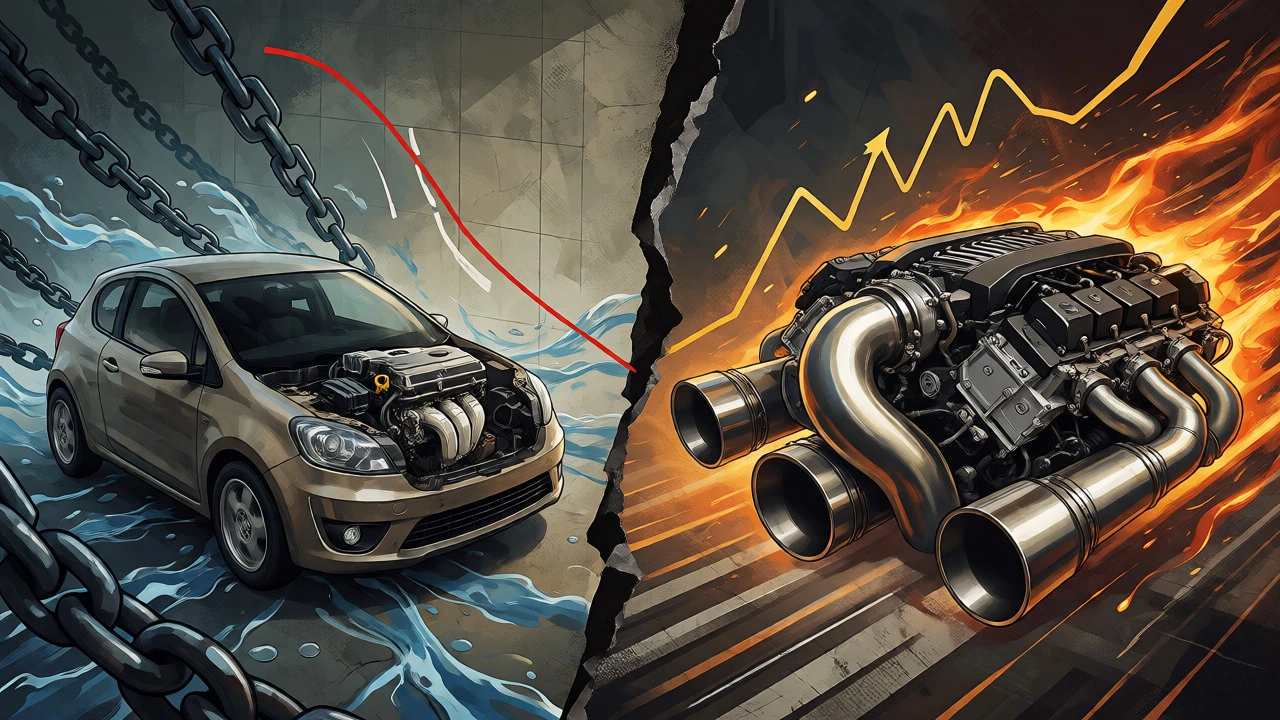
If you are running a stock 2.0-liter naturally aspirated engine, upgrading to a 3-inch system might actually make your car slower at low RPMs. But if you have a modified turbocharged V6 or a big-block V8 pushing serious boost, going from a restrictive 2.25-inch pipe to a free-flowing 3-inch setup can unlock significant top-end power. It is not magic; it is fluid dynamics. Let’s break down exactly when this upgrade pays off and when it’s a waste of cash.
The Physics of Pipe Diameter and Backpressure
To understand why size matters, you need to grasp how exhaust gases move. When an engine burns fuel, it creates high-pressure gas that needs to exit the cylinders quickly so fresh air can enter. This process is called scavenging. A pipe that is too small acts like a kinked hose-it restricts flow, creating backpressure. This forces the engine to work harder to push gases out, stealing horsepower.
However, speed is just as important as volume. If the pipe is too large for the amount of gas being produced, the gas velocity drops. Slow-moving gases don’t create the vacuum effect needed to pull the next batch of exhaust out of the cylinder. This results in poor low-end torque and sluggish throttle response. The goal is to match the pipe diameter to the engine’s cubic inch displacement and airflow requirements.
There is a common misconception that "bigger is always better." In reality, there is a sweet spot. For most street cars, increasing diameter by 0.5 inches over stock yields noticeable changes. Jumping straight to 3 inches on a small engine often leads to a "flat" powerband where you lose mid-range punch in exchange for a slight top-end gain that you rarely use in daily driving.
When Does a 3 Inch Exhaust Actually Help?
A 3-inch exhaust system shines in specific scenarios. It is designed for engines that move a massive volume of air and fuel. If you are looking for real performance gains, check if your vehicle fits one of these profiles:
- Turbocharged Engines with High Boost: If you are running 15 psi or more, the sheer volume of exhaust gases requires larger pipes to prevent choking the turbo. A 3-inch downpipe and cat-back system allow the turbine to spool faster and sustain higher RPMs.
- Large Displacement Naturally Aspirated Engines: Think V8s (5.0L+) or large inline-sixes. These engines produce huge pulses of gas. A 2.5-inch pipe might be sufficient for stock power, but once you add headers and camshafts, 3 inches becomes necessary to support the increased flow.
- High-Revving Modified Builds: If you are building a track car that spends most of its time above 5,000 RPM, backpressure at high speeds becomes critical. A 3-inch system reduces resistance at peak RPM, allowing the engine to breathe easier when it is working hardest.
In these cases, you aren't just adding noise. Dyno tests frequently show gains of 10-15 wheel horsepower (whp) on properly built turbo systems when moving from a restrictive 2.25-inch or 2.5-inch setup to a full 3-inch stainless steel system. On a heavily modified LS swap, gains can exceed 20 whp.
The Downside: Why Bigger Can Be Worse
If you put a 3-inch exhaust on a stock Civic, Golf, or Focus, you will likely notice a dip in performance below 3,000 RPM. This is known as losing low-end torque. Because the exhaust gas velocity slows down in the wider pipe, the scavenging effect weakens. Your car feels lazy off the line. You have to press the accelerator deeper to get the same response, which ironically hurts fuel economy in city driving.
Another major factor is cost and complexity. A true 3-inch system isn't just about swapping a muffler. To get the benefits, you usually need to change the entire path:
- Downpipe: The pipe coming directly off the turbo or headers. This is the biggest restriction point.
- Catalytic Converters: Stock cats are often sized for smaller pipes. You may need high-flow metallic cats matched to the 3-inch diameter.
- Mufflers: Standard mufflers are designed for 2.25-inch or 2.5-inch inlets/outlets. Using a 3-inch inlet on a standard muffler defeats the purpose. You need a dedicated 3-inch core.
- Tips: While cosmetic, tips should match the diameter for aesthetic balance.
This means a 3-inch upgrade is rarely a DIY bolt-on job for beginners. It often requires welding, custom fabrication, and potentially a tune to adjust air-fuel ratios for the new flow characteristics.

Comparing Exhaust Diameters: What Fits Your Car?
Choosing the right size isn't guesswork. It follows general rules based on horsepower potential. Here is a quick reference guide to help you decide if 3 inches is overkill or underpowered for your build.
| Pipe Diameter | Ideal HP Range (Wheel) | Best Engine Type | Low End Torque Impact |
|---|---|---|---|
| 2.25 Inches | Up to 250 whp | Stock NA 4-cylinders | Optimal / No Loss |
| 2.5 Inches | 250 - 350 whp | Tuned Turbo 4-cyl / NA V6 | Negligible Loss |
| 3.0 Inches | 350 - 500+ whp | High Boost Turbo / Large NA | Noticeable Loss on Small Engines |
| 3.5 Inches+ | 500+ whp | Race Cars / Big Block V8 | Significant Loss on Street |
As you can see, the 3-inch mark is the threshold for serious power. If your car makes less than 300 wheel horsepower, sticking with 2.5 inches is usually the smarter choice. You keep your low-end grunt while still getting a sound upgrade and minor top-end relief.
Sound Quality: The Subjective Gain
Let’s be honest: half the reason people upgrade exhausts is for the sound. A 3-inch system produces a deeper, more aggressive tone than a 2.5-inch setup. The larger volume allows lower frequencies to resonate, giving that classic "rumble" associated with muscle cars and supercars.
However, bigger pipes also mean more drone. Drone is that annoying hum inside the cabin at highway speeds (usually between 2,000 and 3,000 RPM). Without proper baffling or resonators, a 3-inch system can become unbearable on long trips. If you value comfort, look for systems with active valves or high-quality internal baffles. Pure straight-pipe 3-inch setups are loud, raspy, and often fail MOT inspections in the UK due to excessive noise levels.
Installation and Tuning Requirements
Swapping to a 3-inch exhaust is not just a mechanical change; it is an electronic one. Modern engines rely on oxygen sensors (O2 sensors) to monitor exhaust composition. If you remove catalytic converters to fit a larger pipe, or if the flow changes significantly, the ECU (Engine Control Unit) may throw error codes or run rich/lean.
You almost certainly need a remap or tune after installing a 3-inch system on a turbocharged car. The ECU needs to know that the engine can now breathe better. A tuner can adjust ignition timing and fuel maps to take advantage of the reduced backpressure. Without a tune, you might leave 5-10% of your potential gains on the table, or worse, drive with a check-engine light permanently illuminated.
Final Verdict: Is It Worth It?
So, does a 3-inch exhaust make a difference? Yes, but only if your engine demands it.
If you are driving a stock family hatchback, save your money. A 2.5-inch cat-back will give you a nicer sound and a tiny power bump without ruining your low-end torque. But if you are pushing a turbocharged engine beyond 350 horsepower, or building a high-revving V8, a 3-inch system is practically mandatory to let the engine perform as intended. It removes the bottleneck, allowing the car to scream up to the redline. Just remember: pair it with a good tune, expect some cabin drone, and ensure your local regulations allow the noise level.
Will a 3 inch exhaust increase fuel efficiency?
Not necessarily. On a small engine, a 3-inch exhaust can actually decrease fuel efficiency in city driving because the loss of low-end torque encourages heavier throttle inputs. On a high-performance engine already operating at high loads, the improved scavenging might slightly improve efficiency at high speeds, but the primary goal is power, not MPG.
Is a 3 inch exhaust louder than a 2.5 inch?
Generally, yes. Larger pipes allow for deeper, lower-frequency tones which are perceived as louder and more aggressive. However, the actual decibel level depends heavily on the muffler design and whether you have removed the catalytic converter. A well-baffled 3-inch system can be quieter than a poorly designed 2.5-inch straight-through muffler.
Do I need to retune my car for a 3 inch exhaust?
If you are removing catalytic converters or significantly changing the flow dynamics on a turbocharged car, yes. A tune optimizes air-fuel ratios and ignition timing for the new exhaust flow. On naturally aspirated cars with just a cat-back swap, a tune is optional but recommended for optimal performance.
What is backpressure and why does it matter?
Backpressure is the resistance to exhaust gas exiting the engine. Some backpressure is beneficial for maintaining exhaust gas velocity at low RPMs, which helps with torque. Too much backpressure chokes the engine at high RPMs. A 3-inch pipe reduces backpressure, helping high-RPM power but potentially hurting low-RPM torque if the pipe is too large for the engine's output.
Can I mix 2.5 inch and 3 inch pipes?
Yes, many hybrid systems exist. For example, you might use a 3-inch downpipe and mid-pipe but step down to 2.5 inches for the rear mufflers and tips. This compromises between top-end flow and low-end torque preservation, offering a balanced solution for street-driven performance cars.