Exhaust Upgrade & Myth Calculator
Select Your Modification
Choose the part you are considering installing to see the realistic impact on your vehicle.
Analysis: Exhaust Tip
Myth Buster Simulator
Myth: Size Matters
FALSE"A larger tip diameter equals more horsepower."
Myth: Titanium Speed
MISLEADING"Lightweight titanium tips significantly improve acceleration."
Myth: Pop & Bang
FALSE"The tailpipe creates the aggressive pop and bang sounds."
You walk into a garage or browse an online auto shop, and you see them everywhere. Shiny chrome, aggressive black carbon fiber, titanium with a burnt blue finish. Exhaust tips are the jewelry of the car world. They look great, they make your car sound louder (sometimes), and they promise power. But here is the hard truth that most salespeople won’t tell you: buying a new exhaust tip will not add meaningful horsepower to your engine.
If you are looking for a quick fix to make your sedan feel like a sports car just by swapping the end pipe, you are going to be disappointed. However, understanding *why* they don’t work-and what actually does-is crucial if you want to build a fast, reliable vehicle without wasting money on marketing hype.
The Physics of Airflow and Backpressure
To understand why an exhaust tip doesn’t boost power, we have to look at how an engine breathes. An internal combustion engine works by sucking in air, mixing it with fuel, igniting it, and then pushing the resulting gases out. This cycle happens thousands of times per minute. For the engine to breathe efficiently, the intake must be open, and the exhaust must be clear.
This brings us to the concept of backpressure. In simple terms, backpressure is the resistance the engine faces when trying to push exhaust gases out of the cylinder. High backpressure means the engine has to work harder to expel waste gas, which can leave residual gas in the cylinder and prevent fresh air-fuel mixture from entering. This reduces efficiency and power.
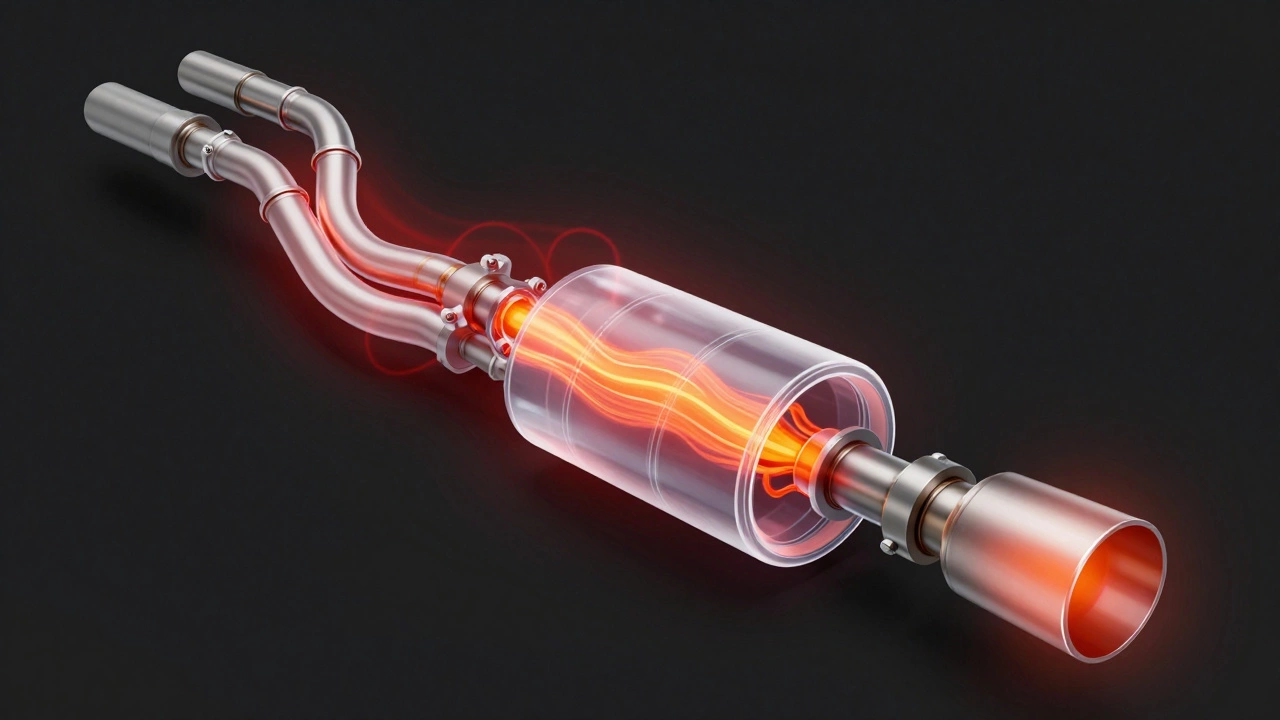
An exhaust system’s job is to minimize this resistance. The critical components for reducing backpressure are the headers, the catalytic converter, the muffler, and the diameter of the piping itself. These parts determine how easily gas flows through the system. The exhaust tip, however, sits at the very end of this journey. By the time the gases reach the tip, they have already passed through all the restrictive elements. Changing the shape of the exit point does nothing to help the gas get out of the restrictive sections earlier in the system.
Why the Shape Doesn't Matter for Power
You might wonder, "But doesn’t a larger opening let more air out?" It’s a logical question, but it misses the physics of fluid dynamics in a pressurized system. Imagine drinking a thick milkshake through a straw. If you widen the very end of the straw where it enters your mouth, does it become easier to suck the shake up? No. The restriction is still in the narrow part of the straw near the cup.
In your car, the "narrow straw" is the rest of the exhaust system. Whether you have a small oval tip or a massive dual-exit cone, the volume of gas exiting is determined by the flow rate upstream. Unless the tip is so small that it acts as a choke (which would be terrible design), the size of the tip has negligible effect on the pressure inside the pipes.
There is a minor exception known as "tuning." Some high-performance exhaust systems use resonators or specific pipe lengths to cancel out pressure waves at certain RPM ranges. This is done deep within the system, usually in the mid-pipe or header section, not at the tailpipe. An aftermarket tip cannot replicate this complex acoustic tuning because it lacks the length and internal geometry required to affect the pressure waves significantly.
What Exhaust Tips Actually Do Change
If they don’t add power, why do people buy them? The answer lies in two areas: aesthetics and acoustics. Let’s break down what you are actually paying for.
- Visual Appeal: This is the primary driver. A stock exhaust often ends in a plain, rusted metal pipe hidden under the bumper. An aftermarket tip extends past the bumper, drawing attention to the rear of the car. Materials matter here too. Stainless steel offers durability and a classic look, while titanium is lighter and develops a unique heat discoloration over time. Carbon fiber tips are purely cosmetic, offering a lightweight, aggressive appearance without any functional benefit.
- Sound Modification: While an exhaust tip won’t change the fundamental tone of your engine, it can alter the perceived loudness and pitch slightly. A wider tip may allow low-frequency sounds to escape more freely, making the exhaust note seem deeper. Conversely, a restrictive tip might cause some turbulence, adding a bit of crackle or pop during deceleration. However, these changes are subtle. If you want a dramatic change in sound, you need to modify the muffler or remove the catalytic converter (though the latter is illegal in many jurisdictions).
- Water Management: Some tips are designed with angled cutouts or holes to prevent water from pooling inside the pipe during rain or washing. This helps reduce rust and prevents water from shooting out onto pedestrians when you accelerate after a wash. This is a practical benefit, but it has nothing to do with horsepower.
The Real Sources of Horsepower Gains
If you are serious about increasing your car’s performance, you need to focus on the components that actually restrict airflow or limit combustion efficiency. Here is where you should direct your budget instead of shiny tips.
| Component | Primary Function | Horsepower Potential | Cost Range |
|---|---|---|---|
| Exhaust Tip | Cosmetic finish, minor sound tweak | 0-1 HP (negligible) | $50 - $300 |
| Muffler Delete / Performance Muffler | Reduces restriction, alters sound | 2-5 HP | $150 - $600 |
| Catalytic Converter (High-Flow) | Reduces chemical restriction | 5-10 HP | $400 - $1,200 |
| Headers / Downpipes | Improves scavenging, reduces initial backpressure | 10-25+ HP | $800 - $2,500+ |
| Full Cat-Back System | Optimizes entire flow path | 5-15 HP | $1,000 - $3,000 |
The biggest gains come from improving the "scavenging" effect. Scavenging is the process where the momentum of exiting exhaust gases helps pull the next charge of air-fuel mixture into the cylinder. High-flow headers are engineered to maximize this effect. They have larger primary tubes and optimized collector designs to keep gas moving smoothly. This is where real horsepower lives.
Another major bottleneck is the catalytic converter. Its job is to reduce harmful emissions by trapping pollutants in a honeycomb structure filled with precious metals. This structure creates significant resistance. Upgrading to a high-flow cat (which uses a less dense honeycomb) or a test pipe (which removes it entirely, but is often illegal for street use) can yield noticeable power increases, especially in turbocharged vehicles.
Common Myths and Marketing Hype
The automotive aftermarket thrives on hope. You will often see products labeled as "performance exhaust tips" or "turbo-back style tips." These labels are designed to trigger an emotional response, associating the product with speed and aggression. But let’s dissect the myths.
Myth 1: Larger Diameter Equals More Power. While true for the main piping, applying this logic to the tip is flawed. A 4-inch tip on a 2-inch pipe doesn’t increase flow. It just makes the exit look bigger. In fact, if the tip is too large relative to the pipe, it can create turbulence as the gas expands abruptly, potentially causing a slight loss in efficiency, though this is rarely measurable on a dyno.
Myth 2: Titanium Tips Reduce Weight Enough to Matter. Titanium is indeed lighter than stainless steel. A pair of titanium tips might save you 2-3 pounds compared to heavy chrome-plated steel. On a Formula 1 car, every gram counts. On a 3,000-pound SUV, saving 3 pounds at the rear of the vehicle has zero impact on acceleration, handling, or horsepower. It’s a nice material for its look and corrosion resistance, but don’t buy it for weight savings.
Myth 3: The "Pop and Bang" Comes from the Tip. Those satisfying pops and bangs you hear from modern performance cars are created by fuel management strategies and active valve control, not the tailpipe. The ECU injects extra fuel into the exhaust stream during deceleration, and the hot surfaces ignite it. The tip just lets the sound out. If your stock system is too quiet, a tip alone won’t create this effect; you need a less restrictive muffler or a tune.

When Might an Exhaust Tip Seem to Help?
There is one scenario where changing the exhaust tip might give the *illusion* of more power. This is psychological. A louder, deeper exhaust note can make the driver feel like the car is working harder and accelerating faster. This is known as sensory feedback. When you hear a roar, your brain anticipates speed. This doesn’t change the physics, but it can improve the driving experience and confidence.
Additionally, if your current exhaust tip is severely clogged with rust, debris, or bird nests, removing that blockage will restore the system to its original efficiency. In this case, you aren’t gaining power; you’re recovering lost power. Always inspect your existing system before assuming a new part will fix performance issues.
How to Choose the Right Exhaust Tip
Since you aren’t buying them for horsepower, how do you choose? Focus on fitment, material, and sound preference.
- Fitment: Ensure the inner diameter of the tip matches the outer diameter of your exhaust pipe. Most tips come in standard sizes (2.25", 2.5", 3"). Using a reducer sleeve can bridge small gaps, but a perfect fit looks best and prevents rattling.
- Material:
- Stainless Steel (304 grade): Best balance of price, durability, and look. Resists rust well.
- Chrome Plated: Looks shiny initially but will peel and rust underneath if scratched. Avoid for long-term value.
- Titanium: Premium look, lightweight, unique color shift. Expensive.
- Carbon Fiber: Purely aesthetic. Lightweight but fragile. Can melt if exposed to excessive heat or sparks.
- Style:
- Straight Cut: Classic, clean look. Good for sedans and trucks.
- Roll Edge: Adds a finished, sporty touch. Reduces sharp edges.
- Dual Exit: Makes a single pipe look like a twin-exit system. Great for visual width.
- Angled/Cutaway: Aggressive, race-inspired look. Helps with water drainage.
Final Verdict: Look Beyond the Tip
So, do exhaust tips add horsepower? No. They add style, they tweak sound, and they protect the end of your pipe from road debris. If you want to make your car faster, invest in a full cat-back exhaust system, high-flow headers, or an engine tune. These modifications address the root causes of restricted airflow and inefficient combustion.
Think of the exhaust tip as the shoes on your outfit. Nice shoes complete the look, but they won’t make you run faster. If you want to sprint, you need to train your legs. In automotive terms, that means upgrading the engine and the core exhaust plumbing. Save your money for the parts that matter, and buy the tip only if you love the way it looks.
Can a larger exhaust tip increase horsepower?
No. Increasing the size of the exhaust tip does not reduce backpressure in the rest of the exhaust system. The flow rate is determined by the headers, catalytic converter, and muffler. A larger tip only changes the appearance and may slightly alter the sound, but it will not result in measurable horsepower gains.
Do titanium exhaust tips make a difference?
Titanium tips are lighter and more corrosion-resistant than steel, but the weight savings (usually 2-3 lbs) are negligible for overall vehicle performance. They offer a premium aesthetic and unique heat discoloration, but they do not add horsepower or significantly improve acceleration.
Will an exhaust tip make my car louder?
Yes, but only slightly. An exhaust tip can amplify low-frequency sounds and reduce some resonance, making the exhaust note appear deeper or louder. However, for a significant increase in volume, you need to modify the muffler or install a straight pipe, as these components control the majority of sound dampening.
What exhaust modifications actually add horsepower?
To gain real horsepower, focus on high-flow headers, downpipes, high-flow catalytic converters, and performance mufflers. These components reduce backpressure and improve exhaust scavenging, allowing the engine to breathe more efficiently. A full cat-back exhaust system typically offers the best balance of sound and modest power gains.
Is it worth buying expensive performance exhaust tips?
Only if you value the aesthetics and sound quality. "Performance" is a marketing term in this context. Expensive tips made of titanium or carbon fiber look great and last longer, but they do not provide a return on investment in terms of speed or power. Buy them for style, not for performance metrics.