Car Radiator Diagnostic Checker
Select the symptoms you are experiencing with your vehicle to receive a preliminary diagnosis of your cooling system health.
Please select at least one symptom above to see results.
You're cruising down the highway, and suddenly that temperature gauge starts creeping toward the red zone. It’s a driver's worst nightmare, but before you panic about a blown head gasket or a seized engine, there's a more common culprit: your car radiator. This component is essentially the heart of your cooling system, responsible for dissipating heat from the engine coolant. When it fails, things go south fast. But how do you know if the radiator itself is the problem versus just a low coolant level or a stuck thermostat? The answer lies in specific symptoms and simple visual checks you can perform yourself.
The Obvious Warning Lights: Temperature and Steam
The most direct sign that something is wrong with your cooling system is an overheating engine. If your dashboard temperature gauge spikes above normal operating range (usually around 195°F to 220°F), stop driving immediately. Continuing to drive an overheating car can warp the cylinder heads or crack the engine block, turning a $300 repair into a $3,000 disaster.
But overheating isn't always gradual. Sometimes, you'll see steam pouring from under the hood. This usually means hot coolant has leaked onto a hot part of the engine or the exhaust manifold. While this confirms a leak exists, it doesn't automatically mean the radiator is cracked. A burst hose or a loose clamp can cause the same effect. However, if the steam is accompanied by a sweet, syrupy smell-characteristic of ethylene glycol-based antifreeze-you’re definitely dealing with a coolant leak. Check under the car after it cools down. Puddles of green, orange, or pink fluid are your first clue.
Visual Inspection: What to Look For Under the Hood
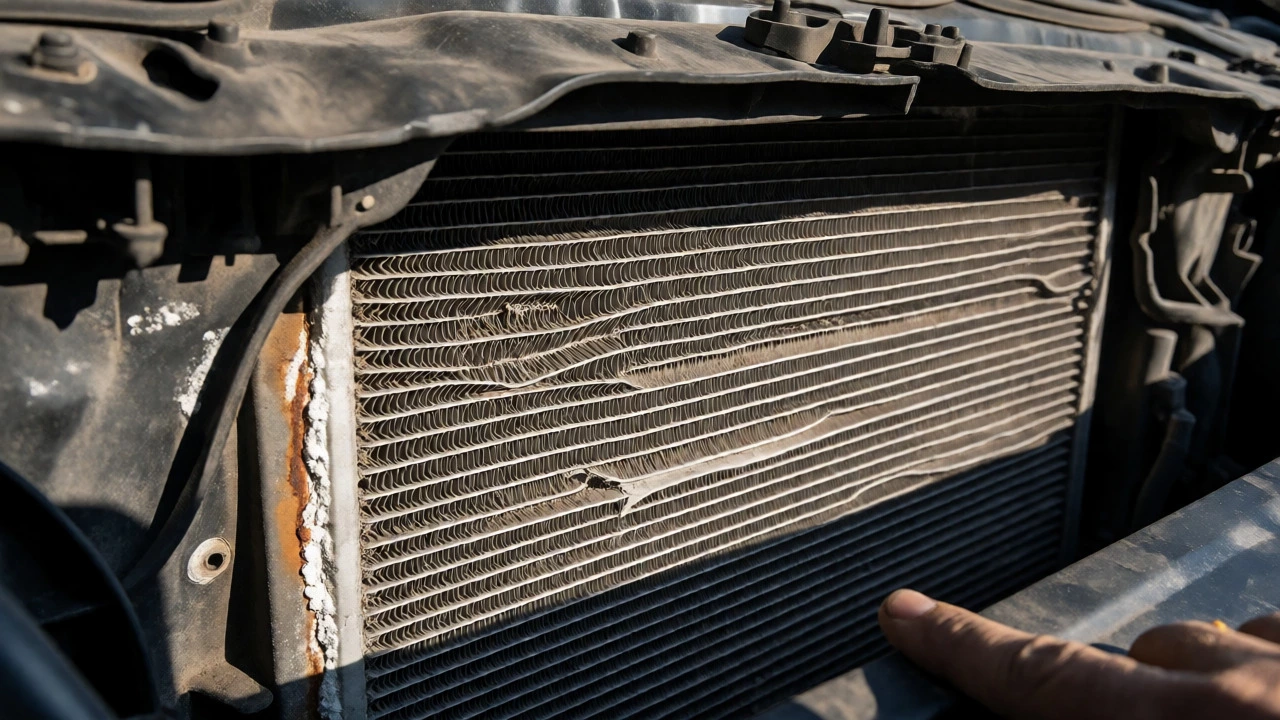
Once the engine is cool enough to touch (wait at least 30 minutes), pop the hood. You don’t need a mechanic’s eye to spot major issues. Start by looking at the radiator core, which is the finned metal block behind the front grille.
- Bent Fins: If the thin aluminum fins are crushed or bent over, airflow is restricted. This reduces cooling efficiency, causing temperatures to rise even if the coolant level is fine. You can sometimes straighten these with a radiator comb, but severe damage requires replacement.
- Corrosion and Rust: Look for white, crusty deposits around the tank seams or where the plastic tanks meet the aluminum core. This often indicates a slow leak. If you see rust streaks running down the side of the radiator, moisture has been escaping for a while.
- Physical Damage: Rocks kicked up from the road can dent the core. More than a few dents can collapse internal tubes, blocking coolant flow. Inspect the top and bottom tanks for cracks, especially near the mounting points.
Also, check the coolant reservoir. If it’s consistently empty despite topping it off, you have a leak. If the coolant inside looks like chocolate milk or has oil floating on top, that’s not a radiator issue-that’s likely a blown head gasket allowing oil and coolant to mix. Don’t replace the radiator if the problem is internal engine failure.
The Pressure Test: Confirming the Leak Source
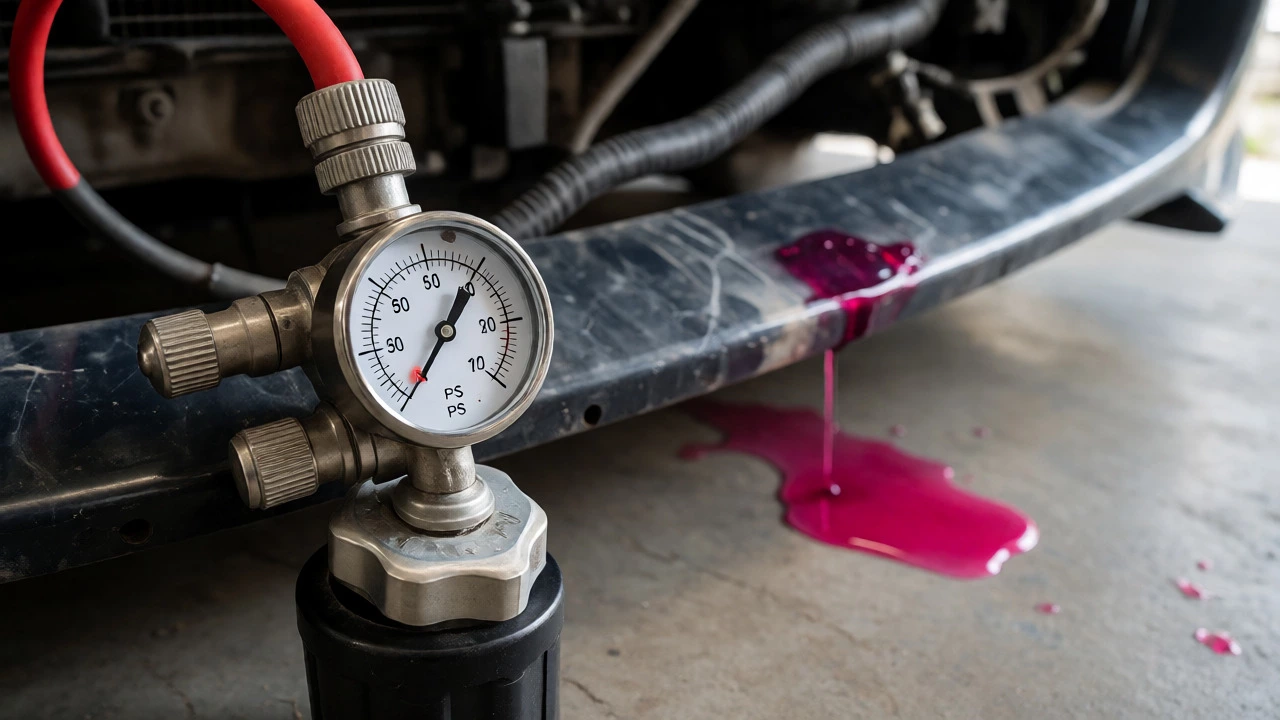
Visual inspections catch obvious problems, but small pinhole leaks can be tricky. These might only leak when the system is pressurized and hot. To confirm if the radiator is the source, use a cooling system pressure tester. This tool attaches to the radiator cap or expansion tank and pumps air into the system to simulate operating pressure (usually 15-16 PSI).
If the pressure holds steady for 15 minutes, your system is sealed tight, and the radiator is likely fine. If the pressure drops, watch the radiator closely. You’ll often see coolant weeping from a seam or dripping from the drain plug area. If no external leak appears but pressure drops, the leak might be internal (into the cylinders) or elsewhere in the system, like a heater core.
Internal Blockage: When Flow Stops
Radiators don’t just leak; they clog. Over time, old coolant breaks down, forming sludge and scale that blocks the narrow internal tubes. This restricts flow, causing uneven cooling. You might notice the engine runs hot in traffic but cools down on the highway. Why? On the highway, airflow helps, but in traffic, you rely on the fan and proper coolant circulation. If the tubes are blocked, hot coolant stays trapped in the engine.
A simple test involves touching the upper and lower radiator hoses when the engine is fully warmed up. Both should be hot. If one is scalding and the other is lukewarm or cold, coolant isn’t circulating properly through the radiator. This could be a stuck thermostat, but if the thermostat is new and working, the radiator’s internal passages are likely clogged. Flushing might help temporarily, but replacement is often the permanent fix.
Transmission Cooler Failure: The Red Flag
Many automatic transmissions have a cooler line integrated into the bottom of the radiator. If the internal barrier between the transmission fluid and coolant fails, ATF (Automatic Transmission Fluid) mixes with the coolant. This turns your coolant into a reddish-brown mess and ruins the transmission.
If you pull the dipstick and see milky, strawberry-milkshake-like fluid, stop driving. This cross-contamination happens because the transmission cooler tubes corrode and split internally. Replacing the radiator won’t save the transmission if it’s already damaged, but it stops further contamination. Always flush both systems thoroughly after replacing a radiator with a failed internal cooler.
| Symptom | Likely Cause | Action |
|---|---|---|
| Gauge spikes in traffic only | Clogged radiator fins or fan failure | Clean fins; check fan motor |
| Pink/orange puddle under car | External leak (tank/hose) | Pressure test to locate source |
| Coolant smells sweet + low level | Slow leak or evaporation | Inspect seams and caps |
| Milky oil or coolant | Head gasket or trans cooler failure | Engine diagnostic; not just radiator |
| Hot upper hose, cold lower hose | Blocked flow or stuck thermostat | Check thermostat first |
When to Replace vs. Repair
Can you patch a radiator? Sometimes. Aluminum epoxy kits work for tiny holes in the tank, but rarely for core damage. If the plastic tanks are cracked, replacement is almost always better. Plastic becomes brittle with age and heat cycles. A new radiator costs between $80 and $300 depending on your vehicle model, plus labor. Trying to save $100 on a repair that fails two months later leaves you stranded again.
Consider the age of your car. If your vehicle is over 10 years old or has 100,000+ miles, the radiator is nearing the end of its lifespan regardless of visible leaks. Preventive replacement during other major services (like timing belt changes) can save money on labor since the system is already drained and disassembled.
Can I drive with a bad radiator?
It depends on the severity. A small leak might let you drive for days if you keep the coolant topped off. However, if the engine is overheating, do not drive. Even a few minutes of overheating can warp engine components. If the temperature gauge is normal, monitor it closely and get to a shop ASAP.
How much does it cost to replace a car radiator?
Parts typically range from $80 to $300 for standard vehicles. Labor adds another $150 to $400. Total costs usually fall between $300 and $700. Luxury cars or those with difficult access (requiring bumper removal) can exceed $1,000.
Does a bad radiator affect the AC?
Not directly, but indirectly yes. If the engine overheats due to a bad radiator, many cars disable the AC compressor to reduce load on the engine. Additionally, debris clogging the radiator fins also blocks the condenser (which sits in front of the radiator), reducing AC efficiency.
How long do car radiators last?
Most modern radiators last 8-10 years or 100,000-150,000 miles. Factors like using water instead of proper coolant, hitting rocks, or poor maintenance shorten this lifespan significantly.
What color is leaking coolant?
Coolant colors vary by brand and type: green (conventional), orange/pink (extended life), blue (some European), or yellow. Regardless of color, it feels slippery and smells sweet. Do not confuse it with water from the AC drain, which is odorless and clear.