Spark Plug Performance Estimator
Why This Matters
Your spark plugs work constantly during operation, not just for starting. Worn plugs reduce power and fuel efficiency by 5-15%. This tool shows how plug condition affects your engine's performance.
Your Engine Input
Your Estimated Results
Power Output
Fuel Efficiency Impact
Why You Should Care
Each spark plug fires 0 times per second. Worn plugs cause incomplete combustion, leading to:
- More engine misfires (P0300 codes)
- Reduced acceleration
- Higher exhaust emissions
- Early catalytic converter failure
Most people think spark plugs are just there to get the engine started. You turn the key, they fire off a quick spark, and the car roars to life. Then they disappear into the background until the next time you need to start the car. But that’s not the whole story. Spark plugs don’t just quit working after startup. They’re active, essential players the entire time your engine runs.
What spark plugs actually do
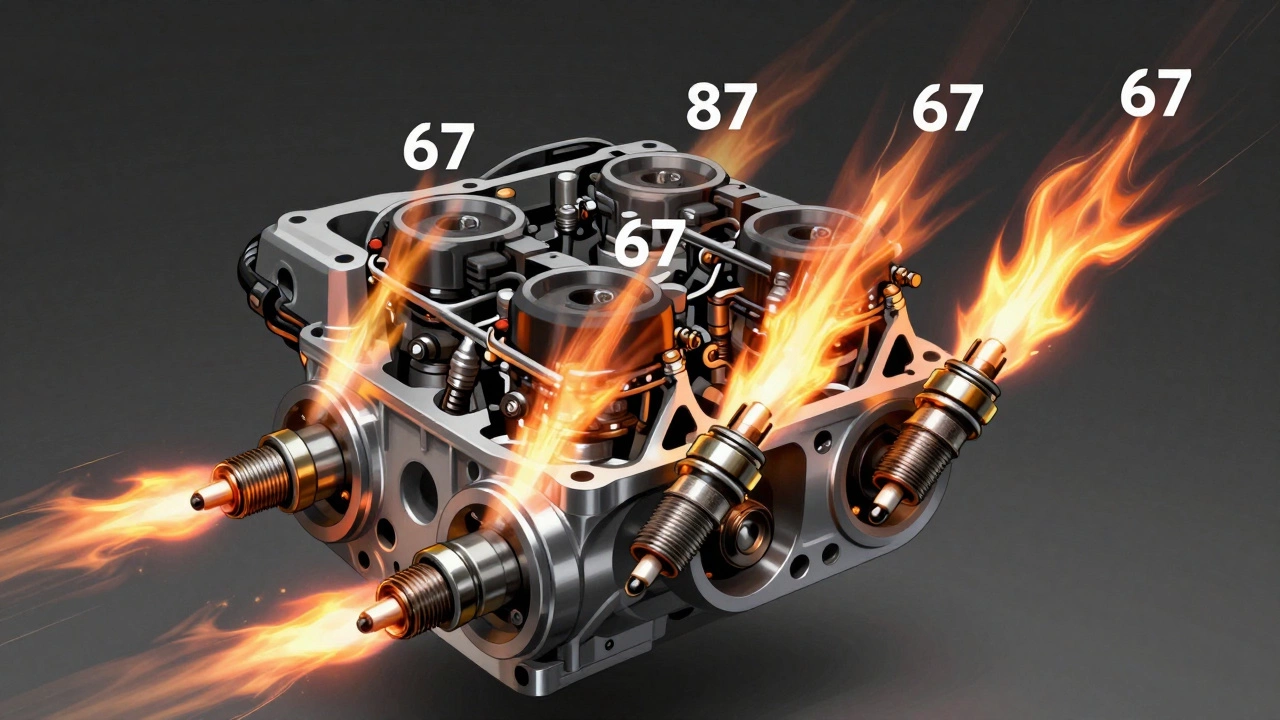
Every time your engine runs, it’s burning fuel. That fuel-air mixture needs to ignite at the exact right moment-thousands of times per minute. That’s where spark plugs come in. They don’t just spark once. They spark constantly. In a four-cylinder engine running at 2,000 RPM, each spark plug fires about 67 times every second. At highway speeds, that’s over 1,000 sparks per second per plug.
These sparks aren’t optional. They’re the only thing that turns the compressed fuel-air mix into power. Without consistent, strong sparks, your engine doesn’t just stumble-it loses power, misfires, and eventually stalls. That’s why a worn or dirty spark plug doesn’t just make starting harder. It makes driving harder too.
Why people think spark plugs are only for starting
This myth sticks around because of how we experience cars. When a car won’t start, the first thing most people check is the battery, then the starter, then the spark plugs. It’s easy to assume the spark plug’s only job is that one-time ignition. But here’s the truth: if your spark plugs were only used at startup, they’d last forever. They wouldn’t need replacing every 30,000 to 100,000 miles.
The real reason they wear out? Constant use. Every spark erodes the electrode. Every combustion cycle leaves carbon deposits. Every time the engine runs hot, the ceramic insulator gets stressed. Spark plugs aren’t passive components. They’re high-temperature, high-voltage workhorses that operate under extreme pressure. They’re literally burning up-slowly-every time the engine runs.
What happens when spark plugs fail
When spark plugs get worn or fouled, you don’t just have trouble starting the car. You get symptoms that show up while you’re driving:
- Engine misfires-especially under acceleration
- Reduced fuel efficiency-your car starts gulping gas
- Rough idle-your car shakes when stopped at a light
- Delayed acceleration-hesitation when you press the gas
- Check engine light-often triggered by misfire codes like P0300
These aren’t startup issues. These are driving issues. A mechanic can’t just jump-start your car and call it fixed. They have to look at the condition of the plugs, check for carbon buildup, measure electrode gap, and sometimes even test for cylinder compression. All because spark plugs are working nonstop.
Modern spark plugs aren’t what they used to be
Older cars used copper spark plugs that needed replacing every 20,000 miles. Today, you’ll find platinum, iridium, and even double-tipped designs that last up to 120,000 miles. But even the best ones wear out. Iridium electrodes are tougher, but they still erode. The gap widens. The insulator cracks. The voltage needed to jump the gap increases until the ignition coil can’t keep up.
Modern engines run leaner fuel mixtures and higher compression ratios. That means the spark has to be hotter, more precise, and more consistent. A weak spark doesn’t just cause a hiccup-it can leave unburned fuel in the exhaust, which damages the catalytic converter. That’s a $1,500 repair you avoid by replacing plugs on schedule.
When to replace spark plugs
Don’t wait for the car to refuse to start. That’s too late. Most manufacturers recommend replacing spark plugs between 60,000 and 100,000 miles. But here’s a smarter rule: if your car has over 75,000 miles and you’ve noticed any of these symptoms, replace them now:
- Gas mileage dropped by more than 10%
- Engine hesitates when you accelerate
- Check engine light came on with a misfire code
- It’s been over 7 years since they were last changed
Even if the car starts fine, worn plugs are quietly stealing power and efficiency. Replacing them isn’t just maintenance-it’s performance restoration.
Spark plugs and engine performance
Performance enthusiasts know this: spark plugs can make or break horsepower. A hotter spark means more complete combustion. More complete combustion means more power and cleaner emissions. That’s why race cars and modified engines use premium plugs with finer electrodes and specialized heat ranges.
But you don’t need a tuned engine to benefit. Even in a daily driver, fresh spark plugs can improve throttle response and smooth out rough idle. You won’t feel like you’re driving a different car-but you’ll feel like your car is running like it should.
Myth busted: spark plugs aren’t just for starting
Spark plugs are one of the most misunderstood parts in your car. They’re not a one-time use item. They’re not a backup system. They’re not a luxury. They’re a core component of the combustion process. Every single time your engine runs, spark plugs are doing their job-over and over, without pause.
If you think your spark plugs are only for starting, you’re missing the bigger picture. They’re the reason your engine runs at all. Not just when you turn the key. Not just in the morning. But every minute you’re on the road.
Don’t wait for failure. Check your owner’s manual. Look at your mileage. If you’re due, replace them. Your engine will thank you-with better fuel economy, smoother performance, and fewer surprises on the road.
Do spark plugs wear out even if I don’t drive much?
Yes. Spark plugs degrade over time, not just mileage. Even if you drive 5,000 miles a year, the ceramic insulator can crack from heat cycles, and moisture or carbon buildup can foul the tip. Most manufacturers recommend replacing spark plugs every 6 to 10 years, regardless of mileage.
Can bad spark plugs cause the check engine light to come on?
Absolutely. A misfiring cylinder due to weak or failed spark plugs triggers a diagnostic code-usually P0300 (random misfire) or P0301 through P0308 (cylinder-specific misfires). The engine control unit detects when combustion isn’t happening properly and turns on the light. Replacing the plugs often fixes it.
Is it safe to drive with worn spark plugs?
You can drive, but not for long. Worn spark plugs cause incomplete combustion, which can overheat the catalytic converter and lead to expensive damage. You’ll also lose fuel efficiency and power. If you notice rough idling, hesitation, or a check engine light, don’t delay-replace them within a few hundred miles.
Do I need to replace all spark plugs at once?
Yes. Even if only one plug looks bad, the others are likely close to failing. Replacing them as a set ensures consistent spark across all cylinders. Mixing old and new plugs can cause uneven performance, misfires, and stress on the ignition system.
Can I clean spark plugs instead of replacing them?
You can clean fouled plugs with a wire brush or spark plug cleaner, but it’s rarely worth it. The electrodes wear down over time, and the gap can’t be restored to factory specs. Even if the plug looks okay, the internal components degrade. For under $10 per plug, replacement is more reliable and safer than cleaning.