Car Battery Compatibility Checker
Determine Battery Compatibility
Enter your battery specifications below to check if it meets the requirements for proper vehicle compatibility.
Getting stranded because your car won’t start isn’t just annoying-it’s expensive, time-consuming, and sometimes dangerous. More often than not, the culprit isn’t a faulty alternator or a dead starter. It’s the car battery. But not just any battery will do. The wrong one can damage your car’s electrical system, fail in freezing weather, or die way before its time. So how do you find the correct battery for your car? It’s simpler than you think.
Start with your car’s manual
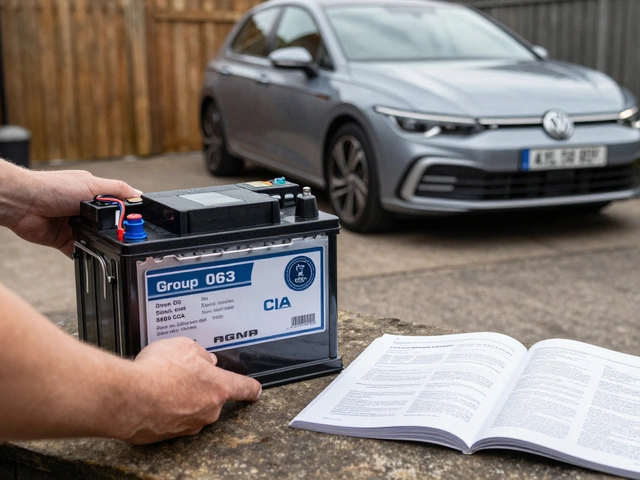
Your owner’s manual isn’t just for emergencies. It’s your first and best source for battery specs. Look for the section on maintenance or specifications. You’ll find three key details: the battery group size, the cold cranking amps (CCA), and the reserve capacity (RC). These aren’t suggestions-they’re requirements.
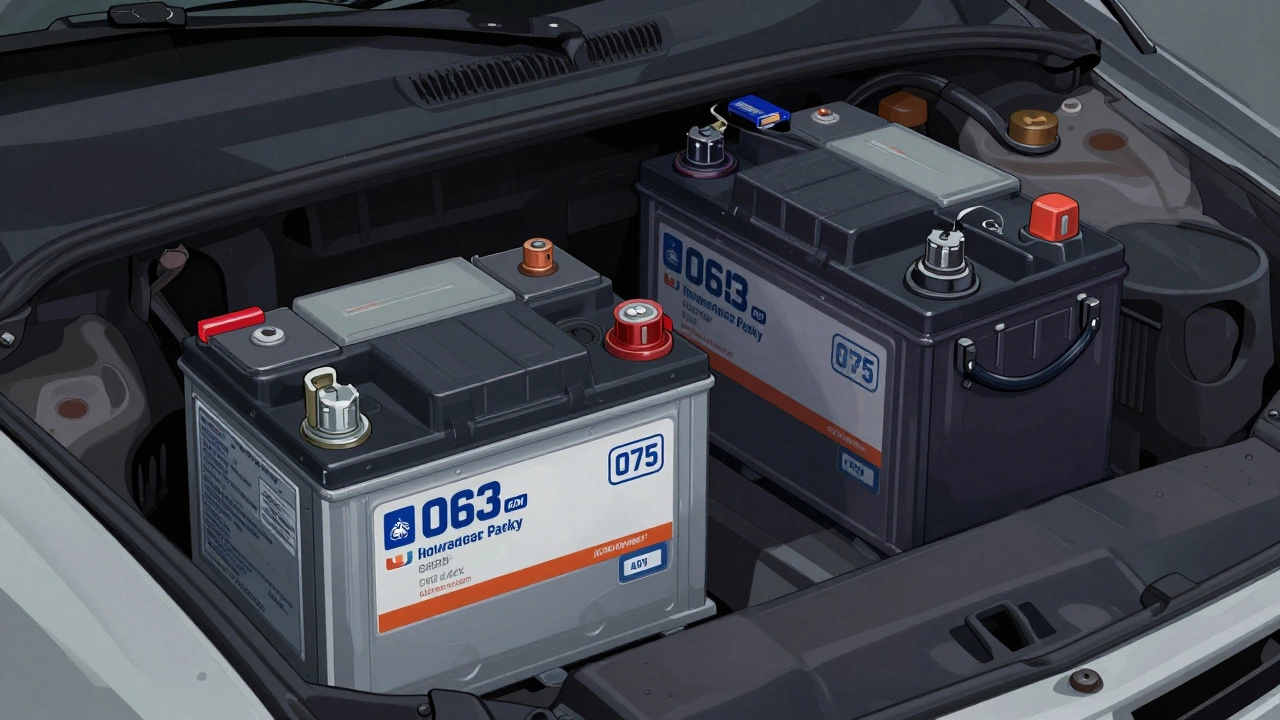
For example, a 2023 Ford Focus in the UK typically needs a Group 050 battery with at least 450 CCA. A 2022 Volkswagen Golf might need a Group 063 with 580 CCA. If you don’t have the manual, check the label on your old battery. It’s usually stamped right on the top or side. The group size looks like a number followed by letters-like 063, 075, or 121. That’s your key.
What does battery group size mean?
Battery group size isn’t about capacity-it’s about physical fit. It tells you the battery’s length, width, height, and terminal placement. If the terminals are on the wrong side or the battery sticks out too far, it won’t fit in the tray. Worse, it might rub against the hood or block the battery hold-down clamp.
In the UK, Group 063 is the most common size for compact and midsize cars. Larger SUVs and diesel trucks often use Group 075 or 121. If you swap a Group 063 for a Group 075, you might get more power-but it won’t fit. Always match the group size exactly.
Cold cranking amps (CCA) matter more than you think
CCA measures how much current a battery can deliver at 0°F (−18°C) for 30 seconds while keeping at least 7.2 volts. In Manchester, winters can dip below freezing for weeks. A battery with 400 CCA might start your car on a mild October day but fail in January.
Manufacturers build in a safety margin. Your car’s recommended CCA is the minimum. Going higher is fine-sometimes better. For instance, if your manual says 450 CCA, a 550 CCA battery is perfectly safe and will give you more reliable starts in cold weather. But never go lower. A 350 CCA battery in a diesel SUV? That’s asking for trouble.
Reserve capacity is your backup plan
Reserve capacity (RC) tells you how long the battery can power your car if the alternator fails. It’s measured in minutes. A battery with 90 minutes of RC can keep your lights and radio running for an hour and a half without the engine running. That’s useful if you get stuck in traffic with the engine off, or if your alternator dies on the way to the garage.
Most standard batteries have 70-100 minutes of RC. Premium models go up to 120. For everyday drivers, 80+ is fine. If you frequently use accessories like heated seats, GPS, or phone chargers with the engine off, go for higher RC.
Lead-acid vs AGM: Which one should you choose?
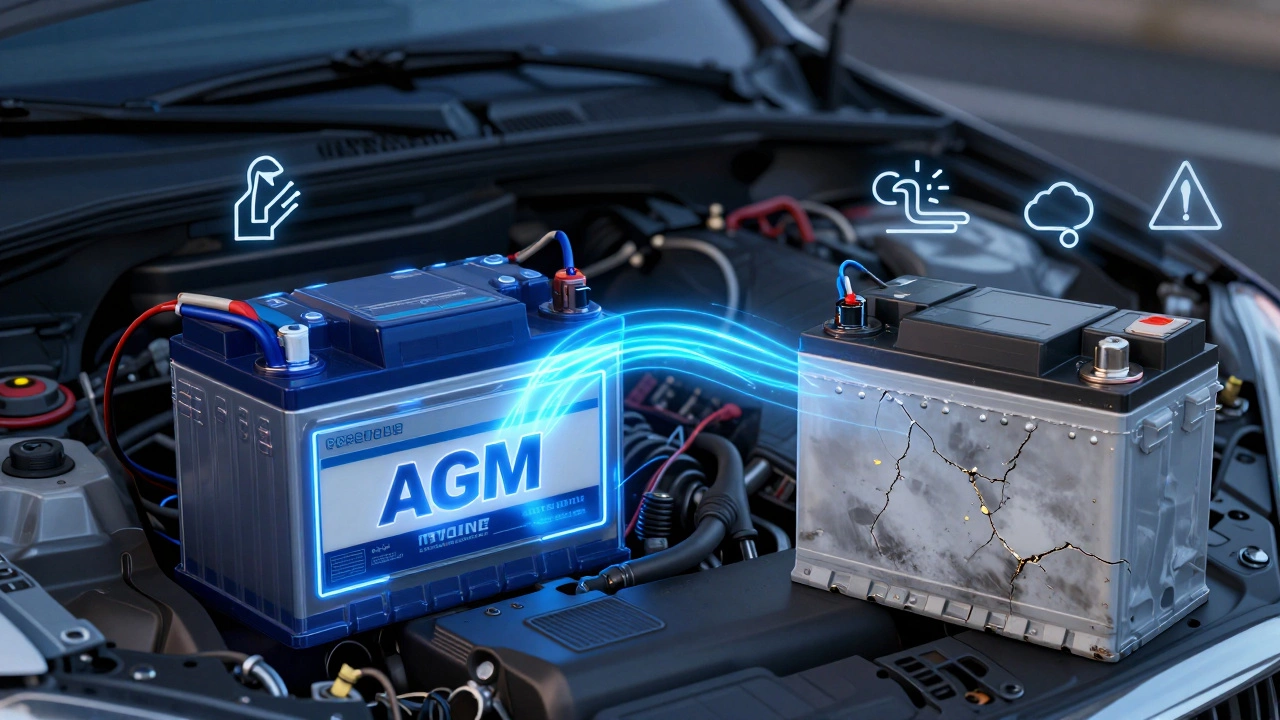
There are two main types of car batteries: flooded lead-acid and AGM (Absorbent Glass Mat).
- Flooded lead-acid is the old-school type. It’s cheaper, widely available, and works fine for basic cars without start-stop systems. Most budget replacements are this type.
- AGM is newer, more durable, and handles deep discharges better. If your car has a start-stop system (common in UK models since 2018), a turbocharged engine, or lots of electronics, you need AGM. It also lasts longer-often 4-6 years vs 2-4 for standard batteries.
Here’s the catch: if your car originally came with an AGM battery, you must replace it with another AGM. Putting a standard lead-acid battery in its place can overload the charging system and damage your car’s computer. Many modern cars monitor battery health and adjust charging voltage. They’ll overcharge a standard battery, boiling off its fluid and killing it fast.
Check your car’s start-stop system
Since 2018, nearly all new petrol and diesel cars sold in the UK have start-stop technology. It shuts off the engine at traffic lights to save fuel. But it puts extra strain on the battery-hundreds of extra starts per week.
Look for a small “ECO” button on your dashboard or a message like “Start/Stop Active” when you start the car. If you see it, your battery is AGM. Replacing it with anything else is a mistake. Even if your old battery looks fine, it’s likely worn out from constant cycling. Most AGM batteries last 3-5 years under start-stop use.
What about battery warranty?
Warranty isn’t just a marketing gimmick. It’s a sign of quality. A good battery comes with a 3-5 year free replacement warranty. Some premium brands offer up to 7 years. But read the fine print. Many warranties are prorated-you pay part of the cost after the first year.
For example, a battery with a 5-year warranty might give you a full replacement for the first 2 years, then 50% off after that. If you’re replacing a battery at year 4, a prorated warranty might not save you much. Look for a long free-replacement period. It’s a better indicator of expected lifespan.
Don’t ignore terminal type and location
Battery terminals come in two main styles: top-post and side-post. Most UK cars use top-post terminals, but some German and Asian models use side-post. The shape and position matter. If the terminals don’t align with your car’s cables, you’ll need adapters-or a different battery.
Also, check polarity. The positive terminal (marked +) should be on the right side for most European cars. If it’s on the left, you’ll have to twist the cables awkwardly or risk shorting them. Always match the terminal layout exactly.
How to test if your battery is failing
You don’t need a mechanic to tell if your battery is dying. Watch for these signs:
- Slow engine crank when starting-especially in the morning
- Dashboard warning light for the battery or charging system
- Electrical glitches: radio resetting, lights dimming at idle
- Corrosion around the terminals (white or green powder)
- Battery age: if it’s over 3 years old and you’re in a cold climate, it’s likely nearing end-of-life
If you notice two or more of these, get it tested. Most auto parts stores in the UK offer free battery tests. They’ll check voltage, CCA, and internal resistance. No charge needed.
Where to buy the right battery
Don’t just grab the cheapest one at the garage. Use your car’s exact specs to shop. In Manchester, places like Halfords, ATS Euromaster, and Kwik Fit all have battery lookup tools. You enter your registration number, and they show you the correct options.
Online retailers like Amazon or Autodoc also let you search by vehicle. Just type in your make, model, and year. They’ll filter for the right group size, CCA, and type. Always double-check the specs before buying.
Final checklist: Before you buy
Before handing over your money, ask yourself:
- Does the group size match my old battery or manual?
- Is the CCA at least as high as the manufacturer recommends?
- Is it the same type (AGM or flooded) as the original?
- Do the terminals match in position and polarity?
- Is the warranty at least 3 years free replacement?
- Will it fit in the tray without touching the hood or other parts?
If you answered yes to all, you’ve got the right battery.
What happens if you get it wrong?
Putting in the wrong battery might seem harmless at first. But here’s what usually goes wrong:
- Too small: Won’t fit. Might not hold charge. Dies faster.
- Too large: Physically won’t fit. Can damage the hood or battery tray.
- Wrong CCA: Struggles to start in cold weather. May strain the starter motor.
- Wrong type (AGM vs flooded): Can fry your car’s charging system. Expensive repair.
- Wrong terminals: Hard to connect. Risk of sparks or short circuits.
There’s no shortcut. The correct battery isn’t about price-it’s about compatibility.
Can I use a battery with higher CCA than recommended?
Yes, using a battery with higher CCA is not only safe-it’s often better. Higher CCA means more starting power, especially in cold weather. As long as the group size and terminal positions match, a higher CCA battery won’t harm your car. Many people upgrade to 550 or 600 CCA for better reliability in winter.
Do I need an AGM battery if my car doesn’t have start-stop?
Not necessarily. If your car was made before 2018 and doesn’t have start-stop, a standard flooded lead-acid battery is fine. But if you drive in cold areas, frequently use electronics with the engine off, or want longer battery life, AGM is still a smart upgrade. It lasts longer and handles deep discharges better.
How long should a car battery last in the UK?
In the UK, a standard flooded battery lasts about 3-4 years. AGM batteries last 4-6 years, especially if you drive regularly and avoid short trips. Cold weather and frequent short drives (under 10 minutes) shorten battery life because the alternator doesn’t get time to fully recharge it.
Can I replace my car battery myself?
Yes, most people can. Turn off the car, disconnect the negative terminal first, then the positive. Remove the hold-down clamp, lift out the old battery, and install the new one in reverse order: positive first, then negative. Always wear gloves and eye protection. If your car has a start-stop system, some models need a battery reset using a diagnostic tool-check your manual or ask the retailer.
Why does my new battery die so fast?
If a new battery dies quickly, it’s usually not the battery’s fault. Common causes: a faulty alternator that isn’t charging, a parasitic drain (like a light left on), or installing the wrong type (e.g., putting a flooded battery in a car that needs AGM). Always get the charging system tested when replacing a battery.
Choosing the right battery isn’t about guessing. It’s about matching your car’s needs. Get the size right. Get the type right. Get the specs right. And your car will start-every time.