Suspension Joint Health Checker
Step 1: Identify Your Symptoms
Check all boxes that apply to your current driving experience.
Select symptoms above and click Analyze to get a preliminary assessment.
Diagnosis
You’re driving down a familiar road, maybe even your daily commute, when you hear it. A clunk. A squeak. Or perhaps just a vague feeling that the steering wheel isn’t quite as crisp as it used to be. It’s tempting to ignore these noises, assuming they’ll go away or aren’t serious. But here is the hard truth: suspension joints are the unsung heroes keeping your tires glued to the pavement. When they fail, you don’t just lose comfort; you lose control.
Figuring out if your suspension components are actually failing can feel like trying to diagnose a ghost. The symptoms often overlap with tire issues, brake problems, or alignment faults. So how do you know for sure? You need to look for specific physical signs, listen for distinct sounds, and perform simple checks that don’t require a mechanic’s lift (though a shop visit is always wise). This guide breaks down exactly what to look for so you can drive with confidence-or know exactly what to tell your mechanic.
The Top 5 Warning Signs of Worn Suspension Joints
Suspension joints-primarily ball joints and tie rod ends-are designed to pivot and rotate under extreme pressure. Over time, the grease inside dries out, dust gets in, and the metal wears against metal. Here are the most common red flags:
- Clunking Noises Over Bumps: This is the classic symptom. If you hear a hollow "thud" or "clunk" when going over speed bumps, potholes, or rough gravel, it usually means there is play in the joint. The component is moving more than it should.
- Vague Steering: Does your car feel like it wanders? Do you find yourself making tiny corrections constantly to stay in your lane? Worn joints introduce slack into the steering linkage, making the car feel loose or imprecise.
- Uneven Tire Wear: Check your tires. If the inner or outer edges are worn down significantly faster than the center, your wheels are likely tilting incorrectly due to failed joints. This is often called "camber wear."
- Vibration at Speed: While this can be a tire balance issue, severe vibration through the steering wheel at highway speeds can indicate a failing ball joint that is allowing the wheel hub to wobble.
- Pulling to One Side: If you let go of the wheel on a straight, flat road and the car immediately drifts left or right, one side of your suspension might be sagging or binding due to a stuck or broken joint.
Ball Joints vs. Control Arm Bushings: Know the Difference
Not all suspension noise comes from ball joints. Often, the culprit is the rubber bushings inside your control arms. Confusing the two can lead to unnecessary repairs. Ball joints are metal-on-metal pivots, while bushings are rubber isolators that cushion movement.
When a ball joint fails, it typically creates sharp, metallic knocking sounds and significant steering looseness. The danger level is high because a completely separated ball joint can cause the wheel to fold inward, leading to a crash.
In contrast, when control arm bushings wear out, the symptoms are more subtle. You might hear low-frequency groaning or creaking during turns, especially at low speeds. The ride may feel harsher, but the steering won't feel dangerously loose until the bushing is completely torn apart. Bushing failure is less catastrophic in the short term but accelerates tire wear and reduces handling precision.
| Feature | Worn Ball Joint | Worn Control Arm Bushing |
|---|---|---|
| Primary Noise | Loud clunking or knocking over bumps | Creaking, groaning, or thudding during turns |
| Steering Feel | Loose, vague, wandering | Stiff, delayed response, slight pull |
| Tire Wear Pattern | Rapid, severe uneven wear (cupping) | Gradual feathering or edge wear |
| Safety Risk | High (potential wheel collapse) | Moderate (handling degradation) |
| Repair Cost | Moderate to High (often requires press) | Low to Moderate (often replace whole arm) |
DIY Checks: How to Inspect Your Joints Yourself
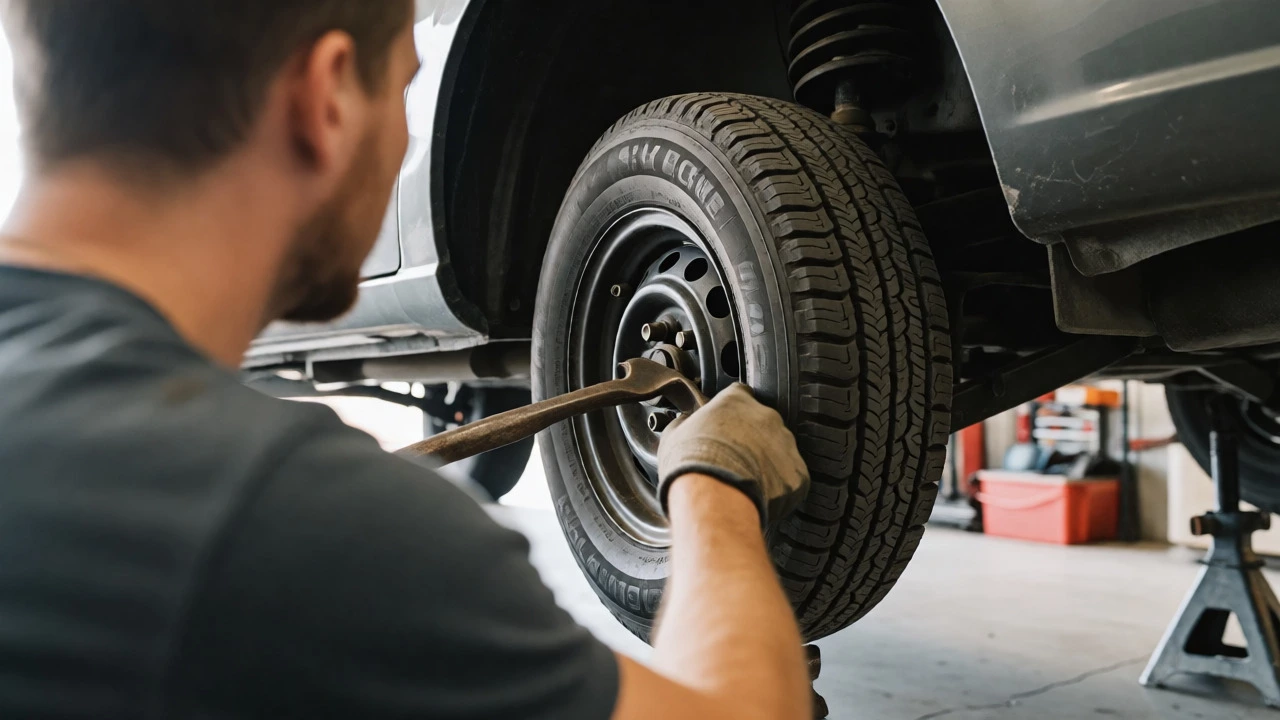
You don’t need expensive tools to get a preliminary diagnosis. Grab a flashlight, a jack, and a sturdy pry bar (or a long screwdriver). Safety first: always use jack stands. Never trust a hydraulic jack alone.
Start with the Jack Test. Lift the front of the car safely so the wheels are off the ground. Grab the top of the tire (12 o'clock position) with one hand and the bottom (6 o'clock) with the other. Rock the tire back and forth vigorously. There should be minimal movement. If you feel a distinct click or pop as the tire moves, or if there is visible play between the tire and the fender, your lower ball joint is likely shot. Next, grab the tire at 3 o'clock and 9 o'clock and rock it side-to-side. Excessive play here points to worn tie rod ends.
For rear wheels or independent rear suspensions, check for vertical play by grabbing the tire at 12 and 6. Since rear wheels usually have fewer steering components, vertical play almost always indicates a bad ball joint or strut mount bearing.
Next, try the Visual Inspection. Look closely at the rubber boot covering the ball joint. Is it cracked, torn, or missing? If the boot is damaged, grease has leaked out, and dirt has gotten in. This guarantees accelerated wear. Even if the joint feels tight now, it will fail soon. Also, inspect the rubber bushings on the control arms. Look for cracks, tears, or separation between the rubber and the metal sleeve. If the rubber looks like dry, flaky pastry, it’s done.
The Parking Lot Test: Listening for Clues
Sometimes the best diagnostic tool is your own body. Park on a smooth, flat surface. Turn the steering wheel lock-to-lock slowly. Listen for any popping or clicking from the front end. Then, get out of the car and push down firmly on the front bumper, releasing it quickly. The car should bounce once and settle. If it continues to bounce like a pogo stick, your shock absorbers are weak, which puts extra stress on your suspension joints. Weak shocks accelerate joint failure because they allow the springs to oscillate too much, hammering the joints repeatedly.
Take a slow drive around an empty parking lot. Make tight U-turns. If you hear a loud crack or pop from the front wheel well, it’s often a sign of a failing CV axle boot or a binding ball joint. While CV axles are different, the noise profile is similar enough to warrant checking both systems simultaneously.
Why Ignoring These Signs Costs More Money
It’s easy to think, "The car still drives fine," and postpone the repair. But suspension joints are part of a system. When a ball joint develops play, it changes the geometry of the wheel. This misalignment doesn’t just annoy you; it shreds your tires. Replacing a set of tires costs $400-$800. Replacing a ball joint assembly might cost $200-$500 per corner depending on the vehicle. Fixing the joint early saves the tires.
Furthermore, worn joints transfer excessive force to adjacent parts. Tie rods, rack-and-pinion steering units, and wheel bearings all suffer when the primary pivot point is loose. By waiting until the joint makes a loud grinding noise, you risk damaging the wheel bearing hub assembly, which is a much more expensive repair. In extreme cases, a seized ball joint can snap while turning, causing immediate loss of steering control.
When to Replace vs. Repair
Can you fix a bad joint without replacing it? Rarely. Modern suspension joints are sealed units. Once the internal grease is gone and metal wear begins, cleaning and regreasing won’t restore structural integrity. Some older trucks allowed for greasable ball joints, where you could pump fresh grease in to flush out contaminants. If your vehicle has grease fittings (zerks), regular maintenance can extend life, but once play exists, replacement is the only safe option.
Most mechanics recommend replacing suspension components in pairs (both left and right sides). Why? Because if one side is worn out, the other is likely close behind. Plus, new joints on one side and old ones on the other can cause uneven handling and premature failure of the new part. Always ask for an alignment after any suspension work. New joints change the wheel angles slightly, and skipping the alignment will waste your investment.
How long do suspension joints last?
There is no fixed mileage, but most modern vehicles see their first suspension wear between 50,000 and 80,000 miles. Vehicles driven on rough roads, in areas with heavy salt usage (which corrodes boots), or with aggressive driving habits may see failures as early as 30,000 miles. Luxury cars with complex multi-link suspensions often have shorter lifespans than standard sedans.
Is it dangerous to drive with a bad ball joint?
Yes. A minor amount of play causes poor handling and tire wear, which is annoying but manageable. However, a severely worn ball joint can separate completely. If this happens while driving, the wheel can collapse inward or outward, causing immediate loss of steering control and potentially rolling the vehicle. If you hear loud clunking or feel loose steering, limit your speed and get it checked immediately.
Can I drive with a torn ball joint boot?
You can drive short distances, but you shouldn't ignore it. The boot keeps grease in and water/dirt out. Once torn, contamination enters rapidly. You might have a few hundred miles before significant wear occurs, but every mile on a rough road accelerates the damage. Replacing just the boot is rarely possible on modern sealed units; usually, the entire joint must be replaced.
Do bad suspension joints affect fuel economy?
Indirectly, yes. Worn joints lead to poor wheel alignment. Misaligned tires create more rolling resistance and drag because they aren't pointing perfectly straight. This forces the engine to work harder, reducing gas mileage. Additionally, if the car vibrates excessively, drivers often compensate with inefficient throttle inputs.
What does a bad tie rod end sound like compared to a ball joint?
Bad tie rod ends primarily cause steering-related issues. You'll notice excessive free play in the steering wheel (the wheel turns a bit before the tires move) and a clicking or popping sound specifically when turning sharply, not necessarily when hitting bumps. Ball joints tend to make clunking noises when going over vertical obstacles like potholes.