Wiper Blade Recommendation Tool
Find the perfect wiper blade type and material for your driving conditions
Enter your details and click "Find My Best Match" to see your recommended wiper setup.
Your Recommendation:
Beam Blade
Ideal for curved windshields and high speeds.
Silicone
Lasts longer and repels water better.
Quick Guide to Picking Blades
- Check your manual: Always verify the exact length (e.g., 26" driver, 18" passenger).
- Match the material: Use silicone for longevity or rubber for a budget-friendly fix.
- Pick the frame: Beam blades for sleekness, Hybrid for versatility, Conventional for cost.
- Verify the fitment: Ensure the adapter matches your car's hook or pin style.
Understanding the Types of Wiper Blades
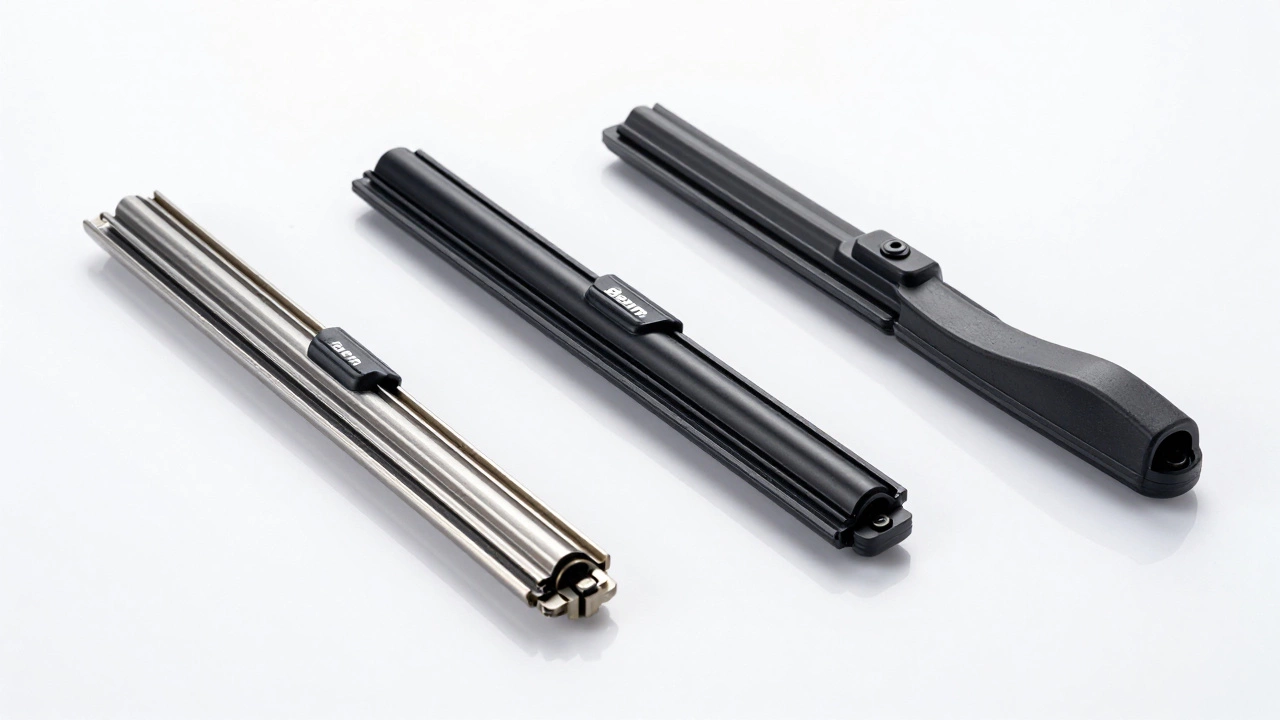
Not all blades are created equal. Depending on what you pay and where you live, you'll encounter three main designs. Conventional Wiper Blades is the traditional design featuring a metal frame that pushes a rubber strip against the glass. These are the cheapest option, but they often struggle in winter because the metal frame can trap snow and ice, preventing the blade from pressing firmly against the windshield.
If you want something more modern, look at Beam Wiper Blades. Unlike the old-school frames, these are a single piece of molded rubber with an internal tension spring. They provide uniform pressure across the entire curve of the glass. Because they have no external metal frame, they are aerodynamic and don't "lift" at high motorway speeds. They are also the go-to choice for cars with curved windshields.
Then there are Hybrid Wiper Blades. Think of these as the best of both worlds. They have a strong internal spring like a beam blade but are covered by a plastic aerodynamic shell. They offer the stability of a conventional blade with the performance of a beam blade. If you do a lot of long-distance driving in varying weather, these are usually the smartest investment.
| Feature | Conventional | Beam | Hybrid |
|---|---|---|---|
| Price | Lowest | Medium | Highest |
| Winter Performance | Poor (Ices up) | Excellent | Great |
| Lifespan | Short | Long | Very Long |
| Pressure Distribution | Uneven | Uniform | Uniform |
Rubber vs. Silicone: Which Material Wins?
The "skin" of the blade is what actually touches your glass. Most cheap blades use Natural Rubber, which is flexible and inexpensive. However, rubber degrades quickly under UV rays. If you park your car in the sun all day, you'll notice the rubber getting hard and brittle, leading to those annoying chatters and streaks after just a few months.
On the other hand, Silicone is a game-changer. It doesn't dry out as fast and can withstand much higher temperatures. One of the coolest things about silicone blades is that they often leave a thin water-repellent layer on the glass as they wipe. This means water beads up and flies off more easily, which is a huge safety boost during heavy rain. While they cost more upfront, they can last twice as long as rubber, making them cheaper in the long run.
Getting the Size and Fit Right
Buying the wrong size is a common mistake. If the blade is too long, it might overhang the edge of the glass or hit the opposite wiper. If it's too short, you'll have a glaring blind spot right in your line of sight. You can find the exact measurements in your owner's manual, but a quick way to check is to take a tape measure to your car. Measure from the end of the arm to the tip of the current blade.
The fitting is where things get tricky. Most cars use a J-Hook connector, which is basically a metal hook that the blade slides into. However, many newer European cars use "side-pin" or "pinch-tab" systems. When you shop for windscreen wiper blades, look for "multi-fit" adapters. These are plastic clips that come in the box and allow one blade to fit five or six different arm styles. Just make sure the adapter clicks firmly into place; a loose wiper is a useless wiper.
When Should You Actually Replace Them?
Don't wait for your wipers to stop working entirely. There are a few clear red flags that tell you it's time for a new set. First, listen for "chattering." If the blade jumps or vibrates across the glass instead of gliding, the rubber has lost its flexibility. Second, look for streaks. If you see thin lines of water left behind, the edge of the blade is likely nicked or worn down.
A good rule of thumb is to replace them every six months, or at the start of every winter. Extreme heat in the summer bakes the rubber, and road salt in the winter eats away at the material. If you notice a buildup of grime on the edge, try cleaning them with a damp cloth and some mild soap. If that doesn't fix the streaking, the material is chemically degraded and needs to be replaced.
Installation Pro Tips to Avoid Damage
One of the most expensive mistakes people make is letting the wiper arm snap back against the glass while the blade is off. The metal arm is under high tension. If it slams down without a blade to cushion it, it can crack your windshield instantly. To prevent this, lay a folded towel across the glass where the arm will land during the installation process.
Also, check your Windscreen Washer Fluid levels. Using wipers on a dry, dirty windshield acts like sandpaper, scratching the glass and wearing out your brand-new blades in record time. Always spray the glass before the first wipe of any journey.
Can I use a different size blade than what is recommended?
It is not recommended. A larger blade can overlap with the other wiper or slide off the edge of the glass, while a smaller blade leaves a gap in your visibility. Stick to the manufacturer's specifications for the safest results.
Why do my new wipers still leave streaks?
This is usually caused by a dirty windshield or a buildup of oil and wax from car washes. Try cleaning your glass with a dedicated glass cleaner or a mixture of white vinegar and water to strip away contaminants. If that doesn't work, check if the wiper arm is bent and not applying even pressure.
How long do silicone wipers actually last?
Depending on the brand and exposure to the elements, silicone blades typically last 1.5 to 2 times longer than standard rubber blades. While rubber may fail after 6-12 months, high-quality silicone can often go 18-24 months before showing significant wear.
What is the difference between a wiper blade and a wiper arm?
The arm is the heavy metal piece attached to the car's motor that moves across the glass. The blade is the replaceable rubber and plastic part that attaches to the end of that arm. You usually only need to replace the blades, unless the arm is bent or the spring has lost its tension.
Do I need to replace both wipers at the same time?
Yes. Both blades are exposed to the same weather and UV rays. If one is worn out, the other is likely close behind. Replacing them as a pair ensures consistent wiping performance across the whole screen.
What's Next?
Now that you've got the right blades, consider checking your wiper motor and the condition of your rubber seals around the window edges. If you find that your wipers are still struggling despite being new, it might be time to look into glass polishing or applying a permanent hydrophobic coating to the windshield to make the water slide off even faster.