Spark Plug Replacement Calculator
Vehicle Information
Most drivers don’t think about spark plugs until their car sputters, misfires, or refuses to start on a cold morning. But spark plugs are one of the most critical parts of your engine’s ignition system-and ignoring them can cost you more than just a failed start. So how often do spark plugs need replacing? The answer isn’t one-size-fits-all, but it’s far simpler than most people think.
Typical Spark Plug Lifespan
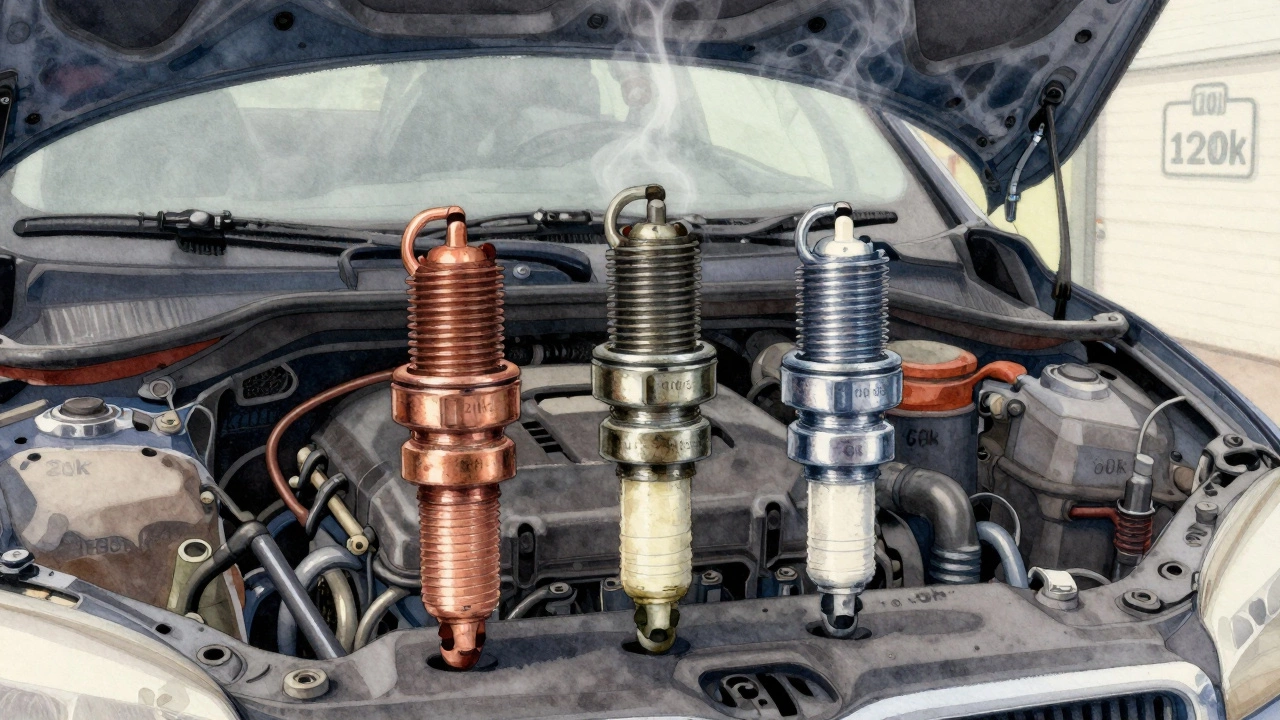
Standard copper spark plugs usually last between 20,000 and 30,000 miles. That’s about 2 to 3 years for the average UK driver who covers 10,000 miles a year. But if your car came with platinum or iridium plugs-which most modern cars do-they can last 60,000 to 100,000 miles. Some high-end models even push beyond 120,000 miles.
Why the big difference? It’s all about the electrode material. Copper conducts electricity well but wears out fast. Platinum and iridium are harder, more heat-resistant, and erode slower. That’s why manufacturers install them in newer cars: fewer replacements, better fuel efficiency, and smoother performance over time.
What Happens When Spark Plugs Go Bad?
Spark plugs don’t just stop working suddenly. They degrade slowly. You might notice:
- Engine misfires, especially when accelerating
- Reduced fuel economy-your tank doesn’t last as long as it used to
- Hard starting, especially in cold or damp weather
- Rough idling or vibrations when stopped at traffic lights
- The check engine light coming on, often with a P0300 code (random misfire)
These symptoms aren’t always spark plugs. A faulty coil pack or dirty fuel injector can cause similar issues. But if your car is approaching the recommended replacement interval and you’re seeing any of these, spark plugs should be the first thing you check.
Manufacturer Recommendations Are Your Best Guide
Never guess. Your car’s owner’s manual tells you exactly when to replace the spark plugs-and it’s based on real-world testing by the manufacturer. For example:
- A 2020 Ford Focus with a 1.0L EcoBoost engine: replace at 100,000 miles
- A 2018 Volkswagen Golf GTI: 40,000 miles for standard plugs, 60,000 for iridium
- A 2022 Toyota Corolla: 120,000 miles with factory iridium plugs
Some manuals say “inspect at 60,000 miles, replace if needed.” That’s a red flag. If your car is 8 years old and you’ve never changed the plugs, even if you’ve only driven 50,000 miles, it’s time to pull them out and take a look.
Driving Conditions Matter More Than You Think
Two people can drive the same car, same mileage, and have totally different plug life. Why? Driving habits and conditions.
If you mostly do short trips-like dropping kids off at school, running errands, or commuting under 5 miles each way-your engine never fully warms up. That causes fuel and oil residue to build up on the electrodes, fouling the plugs faster. In the UK, where winter mornings are damp and many drivers make frequent short journeys, this is a huge factor.
Stop-and-go traffic, dusty roads, or towing heavy loads also wear plugs out quicker. If you drive in these conditions regularly, cut the replacement interval by 20-30%.
Signs You Should Replace Them Sooner
You don’t need to wait for the manual’s deadline. Here are times to act early:
- Your car fails an MOT because of misfires
- You’ve had a recent engine tune-up and the mechanic says the plugs are worn
- Your car has been sitting for over a year without being driven
- You notice a strong smell of unburned fuel from the exhaust
- You’ve added aftermarket performance parts like a high-flow air filter or remapped ECU
Performance mods often increase combustion pressure and temperature. Stock plugs can’t handle it. You might need a colder heat range plug, and replacing them becomes part of the upgrade process.
What About Spark Plug Inspection?
Some mechanics suggest inspecting plugs every 30,000 miles. That’s not a bad idea-but you need to know what to look for.
A healthy plug has light brown or greyish electrodes. Black, sooty deposits mean rich fuel mixture or oil burning. White, blistered electrodes mean overheating-possibly from wrong plug heat range or cooling system issues. Oily residue? That’s a valve seal or piston ring problem. Cracked porcelain? Replace immediately.
If you’re not comfortable pulling them yourself, ask a mechanic to check them during your next service. Most charge less than £20 for this check.
Cost vs. Benefit: Is It Worth It?
A set of four iridium spark plugs costs between £30 and £70. Labour to replace them? Around £60-£100, depending on engine access. Some modern engines-like BMW’s N20 or Ford’s 1.5L EcoBoost-require removing the intake manifold to reach the plugs. That can push labour to £150+.
But here’s the math: worn spark plugs can drop your fuel economy by 10-20%. If you drive 12,000 miles a year and your car does 40 mpg, that’s an extra 60 gallons of fuel annually. At £1.60 per litre, that’s over £300 extra per year. Replacing plugs for £100? That’s a 3x return on investment.
Plus, clean plugs mean fewer emissions. In the UK, where emissions testing is part of the MOT, a misfire can cause an automatic fail.

What to Look for When Buying New Plugs
Never use generic or cheap plugs just to save money. Your engine was designed for a specific heat range, thread size, and electrode gap. Using the wrong ones can damage your engine.
- Match the part number exactly-check your manual or use your VIN
- Stick to trusted brands: NGK, Denso, Bosch, Champion
- Don’t assume “multi-electrode” or “performance” plugs are better-they’re often just marketing
- Pre-gapped plugs are standard now, but always double-check the gap with a feeler gauge
And don’t over-tighten them. Spark plugs are threaded into aluminium heads. Too much torque and you strip the threads. Too little and they can vibrate loose. Use a torque wrench if you can-most plugs need 15-25 Nm.
What Happens If You Don’t Replace Them?
Ignoring worn spark plugs doesn’t just hurt your wallet-it can wreck your engine.
Severe misfires can overheat the catalytic converter, leading to a £1,000+ repair. Unburned fuel can wash down cylinder walls, diluting engine oil and accelerating wear. In extreme cases, the piston or valves can get damaged from repeated detonation.
One mechanic in Manchester told me about a 2017 Honda Civic that hadn’t had plugs changed in 140,000 miles. The driver ignored the check engine light. When it finally stalled on the M60, the plugs were fused to the cylinder head. The head had to be removed, the threads repaired, and two cylinders rebuilt. Total bill: £2,200. The plugs themselves cost £40.
When in Doubt, Replace Them
If you’re unsure, and your car is past the 60,000-mile mark, just replace them. It’s one of the cheapest, most effective maintenance tasks you can do. Even if they’re not dead, they’re likely not performing at 100%.
And if you’re buying a used car with unknown service history? Change the spark plugs immediately. It’s a small cost that gives you peace of mind and better performance from day one.
How often should I replace spark plugs in my UK car?
Most modern cars with iridium or platinum plugs need replacement every 60,000 to 100,000 miles. Older cars with copper plugs need it every 20,000 to 30,000 miles. Always check your owner’s manual first, as manufacturer recommendations vary by engine type and fuel system.
Can spark plugs last 150,000 miles?
Some high-end engines, like those in Toyota, Honda, or BMW models, are designed to use iridium plugs that can last up to 120,000 miles. 150,000 miles is pushing it-even the best plugs eventually erode. At that point, you’re risking misfires, poor fuel economy, and potential engine damage.
Do I need to replace all spark plugs at once?
Yes. Even if only one plug looks bad, the others are likely close to the same wear level. Mixing old and new plugs can cause uneven firing, leading to rough running and potential damage to your ignition coils. Always replace the full set.
Can bad spark plugs cause an MOT failure?
Yes. If your engine is misfiring due to worn spark plugs, the emissions test will detect excess hydrocarbons. This is a major MOT failure. Many drivers don’t realise that the MOT checks for engine performance, not just lights and brakes.
Is it safe to drive with a bad spark plug?
You can drive short distances, but it’s not safe long-term. A misfiring cylinder can overheat the catalytic converter, damage valves, or wash oil off cylinder walls. The longer you drive with bad plugs, the more expensive the repairs become.
If you’re unsure whether your spark plugs need replacing, start by checking your mileage and driving habits. If you’re near the 60,000-mile mark and notice any hesitation or reduced fuel economy, don’t wait. A simple £100 job can save you hundreds-or even thousands-in the long run.