Spark Plug Replacement Calculator
Calculate Your Spark Plug Needs
Based on your vehicle's mileage, age, and driving habits, we'll tell you if you need new spark plugs and how much you could save.
Recommendation
Estimated cost to replace: £30-£60 for parts
DIY vs professional: £0-£80
You’ve heard the warning: spark plugs need replacing. But you’re not hearing any misfires. Your car starts fine. It runs smooth. So why bother? Is this just another mechanic’s money grab? Let’s cut through the noise.
What spark plugs actually do
Spark plugs aren’t decorative. They’re the ignition source in every gasoline engine. Every time your engine fires, a spark plug sends a high-voltage electrical pulse across a tiny gap, igniting the air-fuel mixture inside the cylinder. That tiny explosion pushes the piston down. That’s what turns your crankshaft. That’s what moves your car.
It’s not glamorous. But if one spark plug fails, your engine loses 1/4, 1/6, or even 1/8 of its power-depending on how many cylinders you have. You won’t notice it right away. But over time, your engine starts working harder. Fuel efficiency drops. Emissions creep up. And eventually, you’ll feel it: a hesitation when you press the gas, a rough idle at traffic lights, or worse-a misfire that lights up your check engine light.
How long do spark plugs really last?
Older cars needed spark plug changes every 20,000 miles. Modern cars? Not so much. Most manufacturers now list replacement intervals between 60,000 and 100,000 miles. That’s because today’s spark plugs use materials like iridium or platinum. These are harder, last longer, and resist wear better than the old copper ones.
But here’s the catch: longevity doesn’t mean immunity. Even the best spark plugs degrade. Over time, the electrodes wear down. The gap widens. Carbon builds up. The spark gets weaker. The engine compensates by burning more fuel to make up for the lost ignition power. That’s why your fuel economy might drop 5-10% over 80,000 miles without a spark plug change-even if the car still "runs fine."
Real-world example: A 2019 Toyota Corolla with 92,000 miles and original spark plugs saw a 7.3% increase in fuel consumption after 12 months of driving. After replacement, it dropped back to factory levels. That’s over £120 saved in fuel over a year, just from swapping four tiny parts.
What happens if you ignore them?
Ignoring worn spark plugs doesn’t just hurt your wallet. It can hurt your engine.
Weak sparks lead to incomplete combustion. Unburned fuel flows into the exhaust system. That fuel can overheat and damage your catalytic converter-a part that costs £500 to £1,200 to replace. That’s 10 times the cost of a full spark plug set.
And if misfires become frequent enough, unburned fuel can wash oil off the cylinder walls. That leads to increased engine wear. In extreme cases, it can even cause piston damage. You don’t need a blown engine to feel the pain. Just a rough idle, a check engine light, and a mechanic’s invoice.
How to tell if yours are bad
You don’t need a diagnostic tool to spot failing spark plugs. Here are the real signs:
- Engine misfires-especially when accelerating or climbing hills
- Hard starting, especially in cold weather
- Rough idle-your car shakes when stopped at traffic lights
- Reduced fuel economy-filling up more often than usual
- Check engine light with codes like P0300 (random misfire) or P0301-P0308 (cylinder-specific misfires)
These aren’t vague symptoms. They’re direct results of weak or absent sparks. If you’re seeing two or more of these, your spark plugs are overdue.
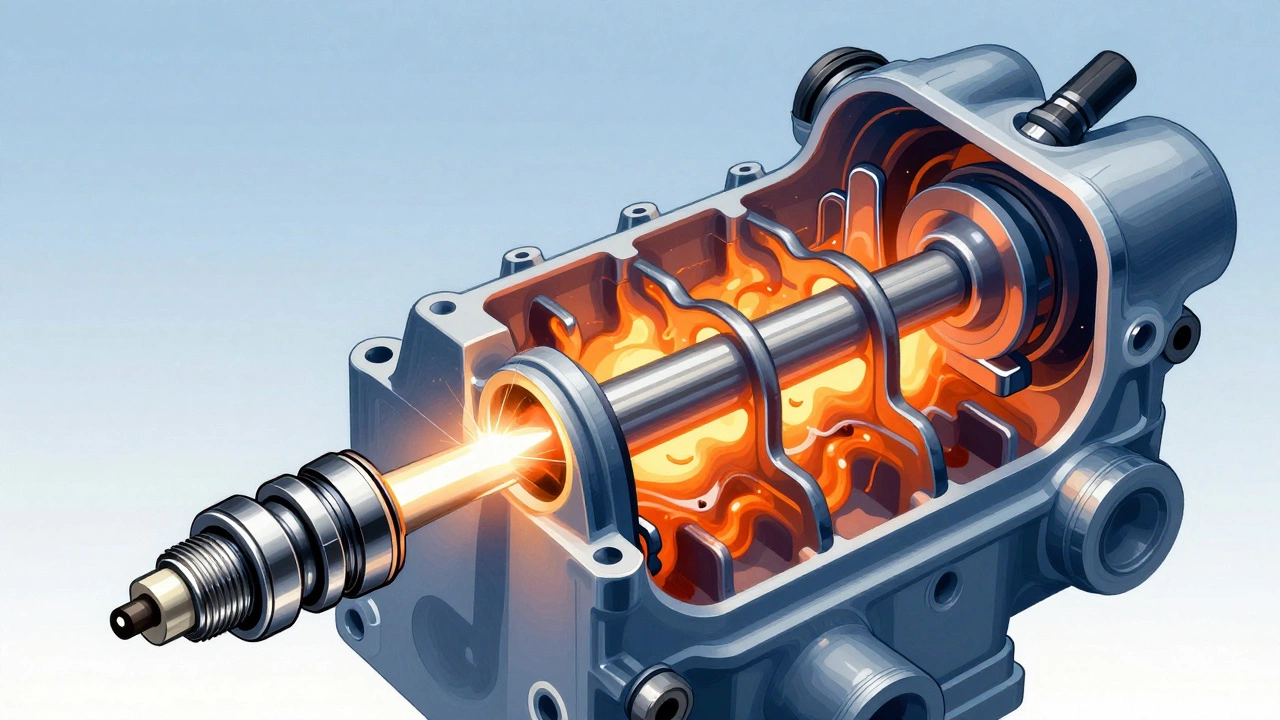
Do you need to replace all of them?
Yes. Always. Even if only one is bad.
Spark plugs wear evenly over time. If one has failed, the others aren’t far behind. Replacing just one creates imbalance. The new plug fires stronger than the old ones. That causes uneven combustion, vibration, and stress on the engine. It’s like replacing one tire on a car with three worn ones-you’re asking for trouble.
Plus, spark plug sets are cheaper than buying them individually. A full set for a four-cylinder engine costs £30-£60. Labor? If you do it yourself, it’s £0. If you pay a garage, it’s usually £50-£80 for the whole job. That’s less than the cost of a single catalytic converter repair.
Can you extend the life with premium fuel or additives?
No. Premium fuel won’t save worn spark plugs. Fuel additives? They might clean your fuel injectors. But they don’t clean the gap between the electrodes. That’s physical wear. No chemical can reverse that.
Some people swear by “spark plug cleaners” or “reconditioning kits.” Don’t fall for it. Spark plugs are precision components. Sandblasting or scraping the electrodes changes the gap permanently. It might seem to work for a few weeks, but you’re just delaying the inevitable-and risking engine damage in the process.
What about electric cars?
If you drive a Tesla, Nissan Leaf, or any full electric vehicle, you don’t have spark plugs. That’s because they don’t have internal combustion engines. No fuel. No ignition. No spark plugs needed.
But if your car runs on gasoline-whether it’s a 2005 Honda Civic or a 2025 Ford Focus-you absolutely need them. No exceptions.

When to replace them
Follow your owner’s manual. That’s your best guide. Most manufacturers recommend replacement between 60,000 and 100,000 miles. But here’s the twist: if you drive mostly short trips in the city, your plugs wear faster.
Why? Short trips mean the engine never reaches full operating temperature. Condensation builds up. Fuel doesn’t fully burn. Carbon accumulates. That’s why someone driving 8,000 miles a year mostly on urban errands might need new plugs at 70,000 miles, while someone with the same car driving 15,000 miles on highways could wait until 95,000.
Rule of thumb: If your car is over 8 years old and you’ve never changed the spark plugs, it’s time. Don’t wait for symptoms.
DIY or professional?
Changing spark plugs is one of the easiest major maintenance tasks you can do yourself. You need a socket wrench, a spark plug socket (with rubber insert), a torque wrench (optional but helpful), and new plugs.
Steps:
- Disconnect the battery (safety first)
- Remove the ignition coils or spark plug wires
- Use the socket to unscrew each plug
- Check the old plugs-black soot means rich mixture, white or melted electrodes mean overheating
- Gap the new plugs to your car’s spec (usually printed on the underhood emissions sticker)
- Screw in new plugs by hand first, then torque to spec (usually 15-20 Nm)
- Reconnect everything
It takes 45 minutes for a four-cylinder engine. You’ll save £70-£100 in labor. And you’ll know exactly what’s in your engine.
Final answer: Do you really need spark plugs?
Yes. Not because they’re expensive. Not because a mechanic told you to. But because they’re essential. They’re the spark that makes your engine work. Ignore them, and you’re gambling with your fuel bill, your emissions, and your engine’s health.
They’re not glamorous. But they’re vital. Change them on time. Save money. Avoid bigger repairs. And keep your car running like it should.
Can spark plugs cause my car to fail an MOT?
Yes. A faulty spark plug that causes a misfire can trigger the check engine light, which automatically fails an MOT. Even if the light isn’t on, excessive emissions from incomplete combustion due to worn plugs can cause a failure under the emissions test. Many MOT failures in the UK are linked to ignition system issues.
Do I need to replace spark plug wires too?
Only if they’re damaged. On modern cars, spark plugs connect directly to ignition coils-no wires needed. Older cars (pre-2010) use spark plug wires. If they’re cracked, brittle, or have carbon tracking, replace them. Otherwise, they can last the life of the vehicle. Always inspect them when changing plugs.
Are expensive spark plugs worth it?
For most drivers, no. Standard iridium plugs from Denso, NGK, or Bosch offer the same performance and lifespan as premium brands at half the price. Unless you’re tuning a high-performance engine or running a turbocharged car under heavy load, you don’t need racing-grade plugs. Stick to OEM specs.
Can I drive with a bad spark plug?
You can, but you shouldn’t. Driving with a misfiring plug for more than a few days risks damaging your catalytic converter, increasing emissions, and causing long-term engine wear. If your check engine light flashes, stop driving immediately-it means active misfiring that can melt engine components.
How do I know which spark plugs to buy?
Check your owner’s manual for the exact part number. If you don’t have it, use your VIN number on a trusted auto parts site like Autodoc, Euro Car Parts, or RockAuto. Never guess. Wrong heat range or thread size can cause engine damage. The right plug fits like a key-it’s not a one-size-fits-all part.
Next steps
If your car is over 60,000 miles and you’ve never changed the spark plugs, check your manual. If it’s been over 8 years, even if mileage is low, get them replaced. Keep a record of when you changed them. Next time, you’ll know exactly when to do it again.
Don’t wait for the car to break. Spark plugs are cheap insurance. A few hours of your time now saves hundreds later.