Spark Plug Lifespan Calculator
Find Your Spark Plug Replacement Interval
Enter your vehicle details to calculate when to replace your spark plugs based on UK driving conditions.
Estimated Replacement Interval
Important Note: These are average estimates based on UK driving conditions. Factors like frequent short trips, fuel quality, and driving style can significantly affect plug lifespan.
For Your Reference:
- Copper plugs: Replace every 2-3 years (15k km/year)
- Platinum plugs: Replace every 4-6 years (15k km/year)
- Iridium plugs: Replace every 6-8 years (15k km/year)
Most drivers in the UK don’t think about spark plugs until their car sputters, misfires, or refuses to start on a cold morning. But spark plugs are the heartbeat of your engine - and knowing how long they last in kilometres can save you money, stress, and breakdowns. So, how many kilometres do spark plugs actually last? The answer isn’t one-size-fits-all, but here’s what you need to know based on real-world driving, car models, and manufacturer specs.
Typical Spark Plug Lifespan in Kilometres
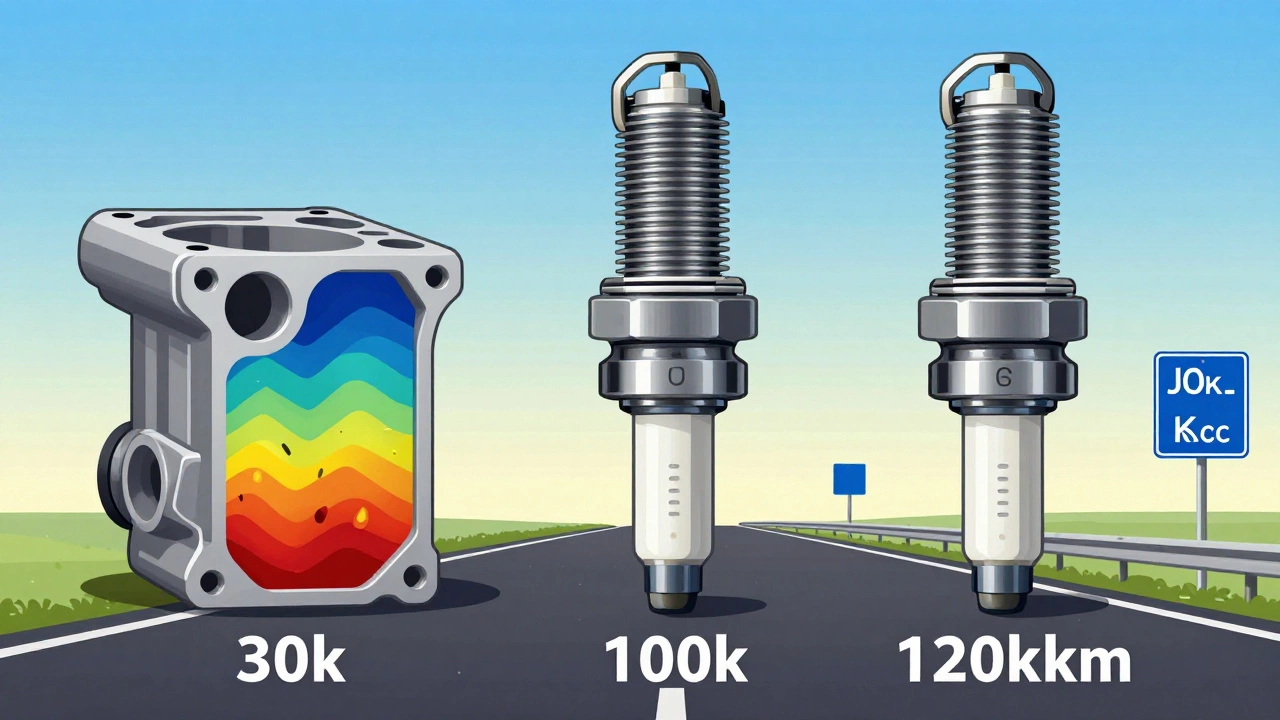
Most standard copper spark plugs last between 30,000 and 50,000 km. That’s about 2 to 3 years for the average UK driver who does 15,000 km per year. But if you’ve got a modern car, chances are it uses longer-lasting plugs. Platinum spark plugs can go 60,000 to 100,000 km. Iridium plugs - the gold standard today - often last 100,000 to 120,000 km. Some high-end engines even push beyond 160,000 km.
Why the big range? It comes down to materials, engine design, and how you drive. A 2015 Ford Focus with copper plugs will need replacing way before a 2023 Toyota Corolla with iridium ones. And if you’re constantly doing short trips around Manchester, your plugs wear out faster than if you’re cruising the M6 on regular highway runs.
How Spark Plug Materials Affect Longevity
Not all spark plugs are made the same. The material used for the centre electrode makes all the difference:
- Copper: Cheapest, least durable. Found in older cars and budget models. Starts to degrade around 30,000 km. You’ll notice rough idling and poor fuel economy before it fully fails.
- Platinum: More heat-resistant than copper. Lasts 60,000-100,000 km. Common in mid-2000s to early 2010s cars. Still reliable but being phased out.
- Iridium: The current industry leader. Harder, finer tip, better spark. Lasts 100,000-120,000 km. Used in most new cars from 2015 onwards. Toyota, Honda, BMW, and Volkswagen all use these as standard.
Manufacturers choose these materials based on engine efficiency. Iridium allows for a smaller electrode, which means a more precise spark - better combustion, less fuel waste, lower emissions. That’s why modern engines need them.
What Shortens Spark Plug Life?
Even the best spark plugs won’t last if your car is under stress. Here are the top 5 killers:
- Short trips: If you mostly drive under 5 km at a time - like dropping kids off at school or running errands - the engine never fully warms up. Condensation builds up, carbon deposits stick, and plugs foul out faster.
- Rich fuel mixture: A clogged air filter or faulty fuel injector can flood the engine with too much fuel. This leaves soot on the plug, shortening its life by half.
- Low-quality fuel: Cheap petrol with too many additives or contaminants can cause pre-ignition or carbon buildup. Stick to major brands like Shell, BP, or Tesco.
- Overheating: If your cooling system is failing, engine temperatures spike. This melts or cracks plug electrodes. Always check coolant levels.
- Wrong plug type: Putting the wrong spark plug in your engine - even if it fits - can cause damage. Always match the heat range and thread size.
One driver in Salford replaced his iridium plugs at 80,000 km - way before the 120,000 km mark - because he was using supermarket fuel and never changed his air filter. His car started misfiring on hills. A simple air filter fix and new plugs brought it back to life.
Signs Your Spark Plugs Are Failing
You don’t need a diagnostic tool to spot worn plugs. Watch for these real-world signs:
- Engine misfires - especially when accelerating or climbing hills
- Hard starting - takes longer than usual to turn over
- Reduced fuel economy - you’re filling up more often
- Rough idle - the car shakes when stopped at traffic lights
- Check Engine Light - often triggered by misfire codes (P0300-P0304)
Some people wait until the car won’t start. Don’t. By then, you’ve already damaged your catalytic converter - and that repair costs 5 times more than new spark plugs.
When to Replace Spark Plugs
Follow your car’s manual. Most manufacturers list replacement intervals in the service schedule. But here’s a practical rule of thumb for UK drivers:
- Every 30,000-50,000 km: If your car is older than 2010 or uses copper plugs.
- Every 60,000-100,000 km: For mid-2010s models with platinum plugs.
- Every 100,000-120,000 km: For modern cars (2015+) with iridium plugs.
Even if your car runs fine, replace them at the recommended interval. Spark plugs don’t fail suddenly - they degrade slowly. You might not notice the drop in performance, but your fuel bill will.

Cost and Labour: What to Expect in the UK
Replacing spark plugs isn’t expensive, but labour varies. A set of four iridium plugs costs between £20 and £40. Labour? Around £60-£100 depending on your garage. Some engines - like those in VWs or BMWs - require removing the intake manifold, which pushes the bill to £150+.
Many UK drivers do it themselves. It’s doable if you’ve got basic tools: a spark plug socket, torque wrench, and gap tool. Always gap new plugs to the manufacturer’s spec - even if they’re pre-gapped. A difference of 0.1 mm can affect performance.
What Happens If You Don’t Replace Them?
Ignoring worn spark plugs doesn’t just hurt performance - it can destroy expensive parts. A misfiring plug means unburned fuel enters the exhaust system. That fuel ignites in the catalytic converter, overheating it. Replacing a catalytic converter in the UK costs £800-£2,000. New spark plugs? £60 total.
Long-term neglect can also cause piston damage, valve wear, or even engine knocking. These aren’t hypotheticals. Mechanics in Manchester see at least one engine rebuild a month caused by ignored spark plugs.
Pro Tips for UK Drivers
- Check your manual - don’t guess. The interval is printed there.
- Keep receipts. Some garages offer lifetime warranties on plugs if installed by them.
- Replace all plugs at once. Mixing old and new ones creates uneven performance.
- Use OEM or trusted brands: NGK, Denso, Bosch. Avoid no-name brands on eBay.
- Consider a full ignition service every 100,000 km - includes coil checks and wire inspection.
There’s no magic number. But if you drive 15,000 km a year and your car is from 2018 or newer, plan to replace your spark plugs around the 100,000 km mark. That’s roughly every 6-7 years. It’s one of the cheapest, most effective maintenance tasks you can do.
Can spark plugs last longer than 120,000 km?
Yes, some modern engines with advanced fuel injection and precise ignition timing can push iridium plugs beyond 120,000 km - even up to 160,000 km. But this isn’t guaranteed. Factors like fuel quality, driving style, and engine condition affect lifespan. Most manufacturers still recommend replacement at 100,000-120,000 km as a safety buffer.
Do I need to replace spark plugs if my car runs fine?
Yes. Spark plugs degrade gradually. You might not notice slower acceleration or higher fuel consumption until it’s too late. Replacing them on schedule prevents hidden damage to your catalytic converter and ensures your engine runs at peak efficiency.
Are expensive spark plugs worth it?
If your car came with iridium plugs, stick with them. They’re designed for your engine’s exact needs. Copper plugs might save money upfront, but they’ll need replacing twice as often, and they reduce fuel economy. Over time, iridium saves you money.
Can I use different brand spark plugs?
You can, but only if they match the exact specifications: thread size, reach, heat range, and electrode type. NGK, Denso, and Bosch are all reliable. Never use a plug with a different heat range - it can cause overheating or fouling.
How do I check if my spark plugs are worn?
Remove one and inspect it. A healthy plug has a light brown or greyish electrode. Black soot means rich fuel. White or melted electrodes mean overheating. Cracked porcelain or eroded electrodes mean it’s time for replacement. If you’re unsure, take it to a garage - they’ll check it for free.