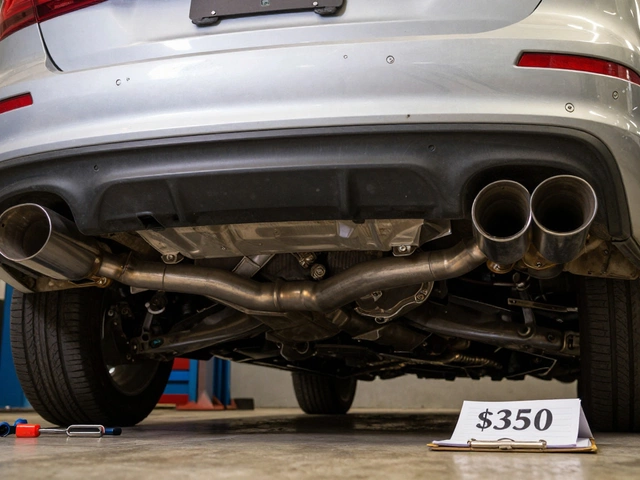
Exhaust System Cost Calculator
How Much Should You Spend?
Find the ideal exhaust system price based on your car's value and needs.
Recommended Exhaust Budget
Enter your car value to see results
Mild Steel
Cost: $150–$400
Lifespan: 2–5 years
Best for: Budget-minded drivers who don't drive in harsh conditions
409 Stainless Steel
Cost: $400–$800
Lifespan: 5–8 years
Best for: Most daily drivers seeking better durability
304 Stainless Steel
Cost: $800–$1,500
Lifespan: 10+ years
Best for: Enthusiasts wanting premium quality and longevity
Titanium
Cost: $1,500–$3,500+
Lifespan: 15+ years
Best for: Race cars or show vehicles where weight matters
Pro Tip
Remember: spend 10% of your car's value on an exhaust, no more. This keeps upgrades proportional and avoids overpaying for vehicles that aren't worth major investments.
Example: A $18,000 car → $1,800 max budget.
When you’re thinking about upgrading your exhaust, the first question that comes up isn’t about sound or style-it’s about money. How much should I spend on an exhaust? There’s no single answer, because what you pay depends on what you want, what your car is, and how you use it. A $200 exhaust won’t do the same thing as a $2,000 one. And neither will necessarily be "better." You’re not just buying a pipe-you’re buying performance, tone, durability, and sometimes, a whole new driving experience.
What You Get at Different Price Points
Exhaust systems fall into clear tiers. Each tier delivers different benefits, and each comes with trade-offs. Knowing these helps you avoid overspending-or worse, buying something that doesn’t meet your needs.
- $150-$400: Bolt-on cat-back systems - These are the most common entry-level upgrades. They replace just the section from the catalytic converter back. Made from mild steel or basic stainless steel, they’re designed for modest gains in sound and a tiny bit of performance. Brands like Borla, MagnaFlow, and Flowmaster offer these. They’re easy to install, often DIY-friendly, and won’t trigger check engine lights. If you just want a deeper rumble without being loud, this is your range.
- $500-$900: Mid-range performance systems - These use 304 stainless steel, have better flow (usually 2.5” to 3” diameter), and may include performance mufflers or resonators. You’ll see real gains in throttle response and a noticeable change in sound. Many of these come with tips that look like they belong on a sports car. This is where most enthusiasts land-enough upgrade to feel the difference without breaking the bank.
- $1,000-$2,000+: High-end custom or full systems - These are built for serious performance. They replace the entire exhaust, including headers or downpipes, and are often mandrel-bent for maximum flow. Materials are premium stainless or even titanium. These systems are common on modified muscle cars, track cars, or imports tuned for power. Installation is rarely DIY. You’ll need a shop. The sound? Aggressive, deep, and unmistakable. The power gains? Up to 15-25 horsepower on high-output engines.
What Kind of Car Are You Working With?
Your vehicle’s engine and purpose matter more than you think. A $1,200 exhaust on a 2015 Honda Civic won’t make it a track beast. But on a 2023 Ford Mustang GT, it could unlock real gains.
- Stock daily drivers - If you drive 30,000 miles a year and care about reliability, stick to a $300-$600 cat-back. You don’t need headers or titanium. Overbuilding here just means more noise, more cost, and less comfort.
- Modified performance cars - If you’ve added a turbo, supercharger, or intake upgrade, your exhaust needs to keep up. A stock replacement won’t cut it. You need a system designed for higher flow. Budget at least $800, and consider going full system if you’re serious.
- Classic or collector cars - If you’re restoring a 1967 Camaro, authenticity matters. You might pay $1,500+ for a reproduction system that matches the original specs but uses modern materials. It’s not about performance-it’s about preservation.
- Off-road or racing vehicles - If you’re not street-legal, you can skip catalytic converters and go straight to a race pipe. These systems cost $500-$1,200 depending on materials. But remember: they’re loud, and they’re illegal on public roads.
Installation: DIY or Pro?
A $700 exhaust might seem like a steal-until you factor in labor. Most shops charge $150-$300 to install an exhaust, depending on complexity. If you’re handy with tools and have a jack and jack stands, you can save that money.
But here’s the catch: if your car has rusted hangers, broken mounts, or corroded bolts, the install gets messy. A simple cat-back can turn into a half-day project. If you’re not confident, paying for professional install is worth it. A bad install leads to rattles, leaks, or even damage to your undercarriage.
Pro tip: Some exhausts come with installation kits. Others don’t. Always check if gaskets, clamps, and hangers are included. If not, budget another $50-$100.
Material Matters
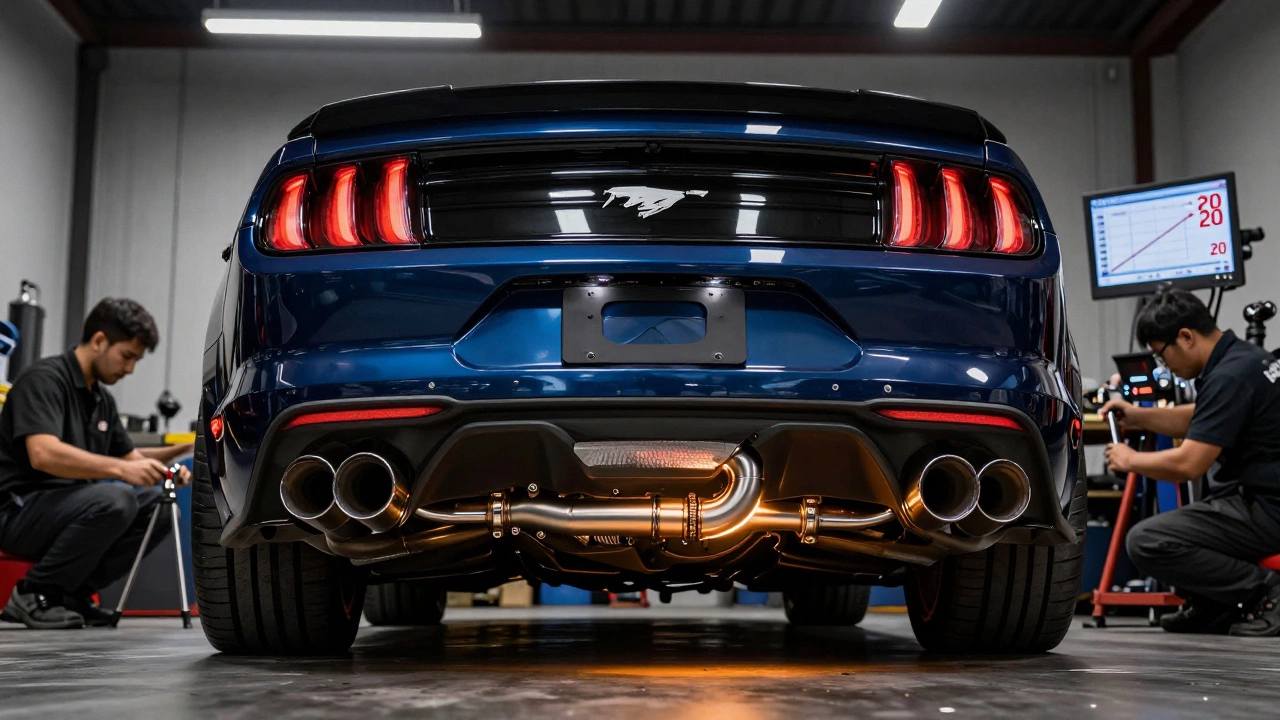
The material of your exhaust affects cost, sound, and lifespan.
| Material | Cost | Weight | Corrosion Resistance | Typical Lifespan |
|---|---|---|---|---|
| Mild Steel | $150-$400 | Heavy | Poor | 2-5 years |
| 409 Stainless Steel | $400-$800 | Medium | Moderate | 5-8 years |
| 304 Stainless Steel | $800-$1,500 | Light | Excellent | 10+ years |
| Titanium | $1,500-$3,500+ | Very Light | Exceptional | 15+ years |
304 stainless is the sweet spot for most people. It doesn’t rust like mild steel, and it’s far cheaper than titanium. Titanium is for race cars or show vehicles. It’s expensive, hard to repair, and often overkill for street use.
What You’re Really Paying For
It’s easy to think you’re paying for sound or power. But you’re really paying for:
- Flow - Less restriction means better engine breathing. That’s where power gains come from.
- Construction - Mandrel bending (not crush bending) keeps exhaust gases moving smoothly. Cheap systems use bends that create turbulence.
- Sound tuning - A good muffler doesn’t just muffle-it shapes tone. Some systems are designed to be quiet at cruise, loud under acceleration.
- Fitment - A system made for your exact model, year, and engine will bolt on cleanly. Generic systems? They might need cutting, welding, or custom hangers.
Common Mistakes to Avoid
- Buying the loudest one - Just because it’s loud doesn’t mean it’s good. Many cheap systems rattle, drone at highway speeds, or sound tinny. Listen to real车主 videos-not YouTube ads.
- Ignoring emissions - Removing your catalytic converter without a proper tune can cause check engine lights, failed inspections, and even fines in some states.
- Choosing based on looks alone - Those flashy tips look great, but if the tubing is too small or poorly routed, you’re losing performance.
- Skipping warranty - Reputable brands offer lifetime warranties on stainless systems. If it’s not covered, you’re on the hook for replacement.
When to Skip the Upgrade
Not every car needs a new exhaust. If your car is:
- Older than 15 years with high mileage
- Used mostly for commuting in heavy traffic
- Has other mechanical issues (oil leaks, transmission problems, etc.)
Then spending over $500 on an exhaust is probably not the best use of your money. Fix the brakes. Replace the suspension. Those changes improve safety and comfort more than a louder exhaust ever will.
Final Rule of Thumb
Here’s the simplest way to decide: spend 10% of your car’s value on an exhaust, no more.
Example: Your 2020 Toyota Camry is worth $18,000. 10% is $1,800. That’s your max. Your 2015 Honda Civic? $8,000 value → $800 max. This keeps upgrades proportional. It stops you from putting $2,000 into a car that’s only worth $3,000.
And if you’re not sure? Go mid-range. A $700-$900 304 stainless cat-back system gives you the best balance of sound, durability, and performance. It’s what most serious enthusiasts choose-and it’s the sweet spot for 8 out of 10 drivers.
Is a louder exhaust better for performance?
Not necessarily. Loudness comes from less muffling, not better flow. A well-designed exhaust can be quiet at idle and loud under load without being obnoxious. Performance comes from reducing backpressure, not volume. Some of the quietest systems on the market actually deliver the biggest power gains.
Can I install an aftermarket exhaust myself?
Yes, if you have basic tools and experience. Cat-back systems are usually bolt-on and take 2-4 hours. But if your car has rusted exhaust hangers, corroded bolts, or a low clearance, it can become a frustrating project. Always check the manufacturer’s instructions. If the kit doesn’t include new gaskets or hangers, buy them separately.
Will an aftermarket exhaust void my warranty?
Under the Magnuson-Moss Warranty Act in the U.S., a dealer can’t void your entire warranty just because you installed an aftermarket exhaust. They can only deny coverage if they prove the exhaust directly caused the failure. For example, if your engine fails and they can prove the exhaust caused a backfire that damaged the catalytic converter, they can deny that repair. But your transmission or AC warranty stays intact.
Do I need a tune after installing an exhaust?
For most cat-back systems, no. But if you’re replacing the downpipe, headers, or removing catalytic converters, you’ll need a tune. Otherwise, your car’s computer will throw error codes. Even some high-flow cat-backs on turbocharged engines benefit from a tune to optimize fuel delivery and timing.
Are titanium exhausts worth it for street cars?
Rarely. Titanium is light and corrosion-proof, but it’s expensive, hard to repair, and overkill for daily driving. Most street cars don’t need the weight savings. You’ll pay 2-3x more than a 304 stainless system for marginal benefits. Save titanium for race cars or show vehicles.